Public Opinion Is the Roadmap for Advocacy Success

January 5, 2026
In advocacy, files can move, stall, or never get off the ground but because decision makers may not know what the public thinks.
They may not know whether the public sees the problem the same way they do (or if something is a problem at all), whether proposed solutions feel realistic, and whether people care enough to act when decisions are made.
Good polling (like we do at Abacus Data) sheds light on these questions before you invest resources into pushing for an outcome. It shows which messages resonate, which assumptions people hold, and where permission for action exists or not. In a democracy the public is the source of authority not a distraction from it.
Below is a simple model you can use to design and evaluate advocacy strategies. It’s a framework our team at Abacus Data uses all the time It focuses on three requirements for success that only proper measurement through polling can reveal.
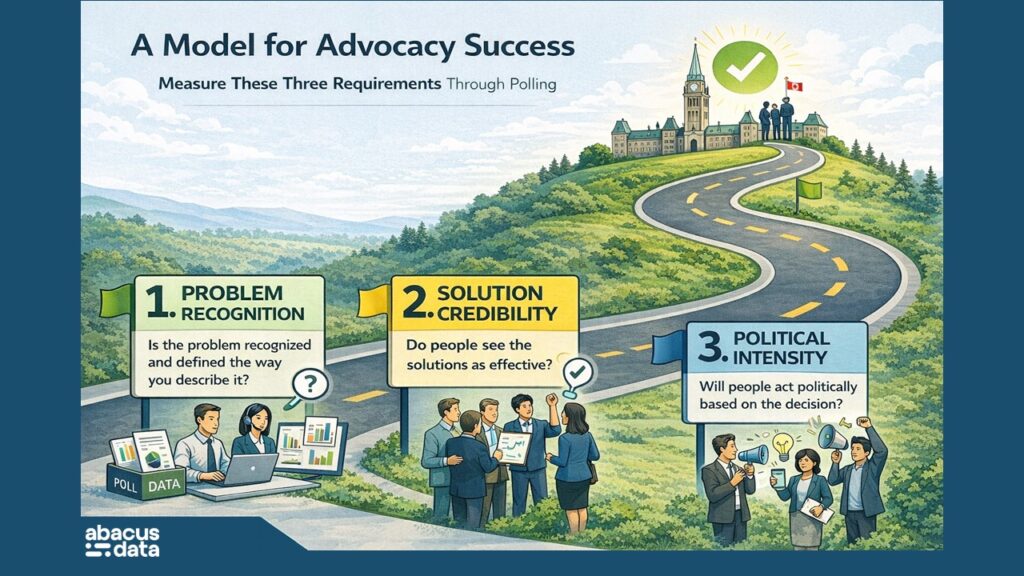
1. Does the Public Recognize the Problem as You Do?
Successful advocacy starts with problem definition. If your audience does not see the problem or defines it differently from you, no amount of solution selling will stick. Decision makers can be unsure whether to act or how to act if they do not know where the public stands.
Public concern about plastic pollution is an example where the problem definition is clear and shared broadly across Canada. Multiple polls have shown overwhelming concern among Canadians about plastic waste and strong support for action. Support levels were high across provinces and political affiliations, with about eight in ten Canadians backing federal action on plastics. Such clarity makes it easier for advocates and lawmakers to argue for stronger policy because the public sees the problem and wants it addressed.
Contrast that with climate policy. Polls show Canadians generally worry about climate change, but there is a significant gap between broad concern and support for specific policies once cost, fairness, and economic trade-offs enter the conversation. Without understanding how the public balances concern with perceived costs, advocates risk pushing solutions that appear technically sound but politically fragile.
Polling also helps you refine the language you use to describe the problem. Different segments of the population may frame the same situation differently. If advocates use technical or abstract terms while the public uses everyday language, a disconnect emerges. Problem definition polling uncovers these disparities so you can adapt your framing.
2. Do People Believe Your Proposed Solutions Are Effective and Feasible?
Once you establish that the public recognizes the problem, the next question is whether they buy your solution.
People do not automatically link an idea to a credible fix. They assess whether a proposed policy will actually work, whether it is fair, and whether it can be implemented without unintended consequences. Measurement here helps advocates understand not just support for the idea but the depth of that support.
Research on Canadian perceptions of carbon pricing illustrates this point. Polls have shown that while a majority of Canadians say climate action is important, fewer are convinced that pricing carbon is effective or understand how incentive payments or rebates work. Without that deeper insight, advocates for carbon pricing can mistake general support for ambiguous backing of a specific policy design. Good polling identifies where communications need to be improved and what barriers remain to broader acceptance.
Feasibility also includes political feasibility. People judge whether governments can implement policies fairly and without undue disruption.
The measurement of perceived effectiveness and feasibility allows advocates to test alternative approaches. It tells you whether your preferred solution resonates and what adjustments make it stronger. Without this, you may advocate for a policy that looks good on paper but is disconnected from how people think it will play out in their lives.
3. Is the Public Willing to Act Politically Based on a Decision?
The third requirement is political intensity. This goes beyond passive support. It measures whether people are willing to reward or punish decision makers based on the outcome.
An issue can enjoy broad passive support yet lack political consequence if people do not care enough to influence decisions. Trouble arises when advocates build strategies around “nice to have” issues that do not move the needle in ways that matter to politicians.
Polling that measures willingness to act politically asks questions like whether people would reconsider their vote, contact elected officials, donate, or participate in demonstrations based on policy decisions. These measures uncover whether support is stable or shallow.
The debate over handgun policy in Canada, for example, shows how intensity matters. Polling has examined views on handgun bans and buyback programs, revealing that opinions are influenced by regional identities, perceived risks, and values. Understanding intensity and trade-offs is crucial for advocacy because a narrow majority might support a policy but lack the intensity to make it consequential for decision makers.
Similarly, research on public views toward health care resource allocation can reveal where support for broader access to family doctors or expanded emergency services is strong enough to influence policy. Without such evidence, advocates may overestimate the political leverage a broad support number suggests.
Measurement should track not just positive reactions but also how people respond if the policy fails to pass or if it is implemented poorly. Does that change how they view leadership? Does it shift trust? Does it alter their willingness to engage politically? These are the real signals policymakers watch.
How to Use This Model in Practice
When you combine these three requirements, you get a diagnostic tool that helps you understand where your advocacy strategy is strong and where it is fragile.
Good polling gives you a layered picture:
- If problem definition is weak, you need to invest in awareness and framing.
- If solutions are doubted, you need credibility, proof points, and clear narratives of how they work.
- If political action is low, you need to build salience, community engagement, and intensity.
This model also helps diagnose why a file is stuck. If people see the problem but do not believe the proposed fix is feasible, your strategy needs refinement. If people support the idea but are not willing to act politically, you may need to focus on messaging that translates support into consequence.
Good Polling Illuminates the Road Ahead
Good polling does not tell you what to think. It tells you how people think. It uncovers assumptions, reveals barriers, and highlights opportunities. It shows where permission exists and where it is fragile.
Public opinion research is not about chasing headlines. It is about illuminating the road ahead so you know how choices will land with the public. It shows how to make decisions land more smoothly or why a decision could backfire if you are trying to stop something. It helps advocates reduce guesswork and plan for contingencies.
At Abacus Data we treat public opinion as a dynamic system. We do not just measure what people think today. We model how opinions form, how they shift, what messages move them, and what trade-offs matter. We measure problem recognition, solution credibility, and political intensity because we know these are the foundations of permission.
We also bring political context and segmentation to our analysis. Public support is rarely one monolithic number. It varies by region, values, lived experience, and trust in institutions. In a time when Canadians feel both anxious and open to leadership, that nuance matters. A policy can have broad support in theory yet fail to gain traction because key segments see it differently.
The best advocacy strategies treat public opinion as an asset to be built, not a hurdle to be managed. This means measuring the right things at the right times with the right level of nuance. It means separating recognition from agreement, agreement from credibility, and credibility from political action.
Politics and public policy are sustained by permission.
When advocates understand whether permission exists, what it is made of, and how it can change, they make better decisions and achieve better outcomes.
Public opinion research does not replace strategy. It strengthens it.
David Coletto is the founder & CEO of Abacus Data. Subscribe to his Subtack – inFocus with David Coletto – for more in-depth polling analysis you won’t find anywhere else.
About Abacus Data
We are the only research and strategy firm that helps organizations respond to the disruptive risks and opportunities in a world where demographics and technology are changing more quickly than ever.
We are an innovative, fast-growing public opinion and marketing research consultancy. We use the latest technology, sound science, and deep experience to generate top-flight research-based advice to our clients. We offer global research capacity with a strong focus on customer service, attention to detail, and exceptional value.
We were one of the most accurate pollsters conducting research during the 2021 Canadian election following up on our outstanding record in 2019.
Contact us with any questions
Find out more about how we can help your organization by downloading our corporate profile and service offering.