From “Carney, Who?” to the Centre of Gravity: 18 Months Through Abacus Data Polling

December 21, 2025
This piece has a simple goal.
It is not to praise Mark Carney or to criticize him. It is not to argue that his rise was inevitable, nor to suggest it was purely accidental. The goal is to understand how someone who was virtually unknown to most Canadians in mid-2024 became Prime Minister less than a year later, and what that transformation tells us about the political moment Canada is in.
I do that by following the data.
Using Abacus Data polling conducted from the summer of 2024 through the end of 2025, this analysis traces Carney’s meteoric rise to the highest political office in the country and situates it in the broader context of a rapidly shifting political market. The focus is not on tactics or personalities in isolation, but on how public opinion evolved, what Canadians were responding to, and why Carney’s particular offer resonated when it did.
If you want to understand Carney’s rise, the first thing to discard is the idea that it was inevitable.
It wasn’t.
It was conditional, contextual, and shaped by forces largely outside his control. His success tells us far less about personal charisma or campaign brilliance than it does about how the political market shifted, who that shift favoured, and why Carney’s particular product fit the moment better than the available alternatives.
Politics, like markets, does not reward effort. It rewards fit.
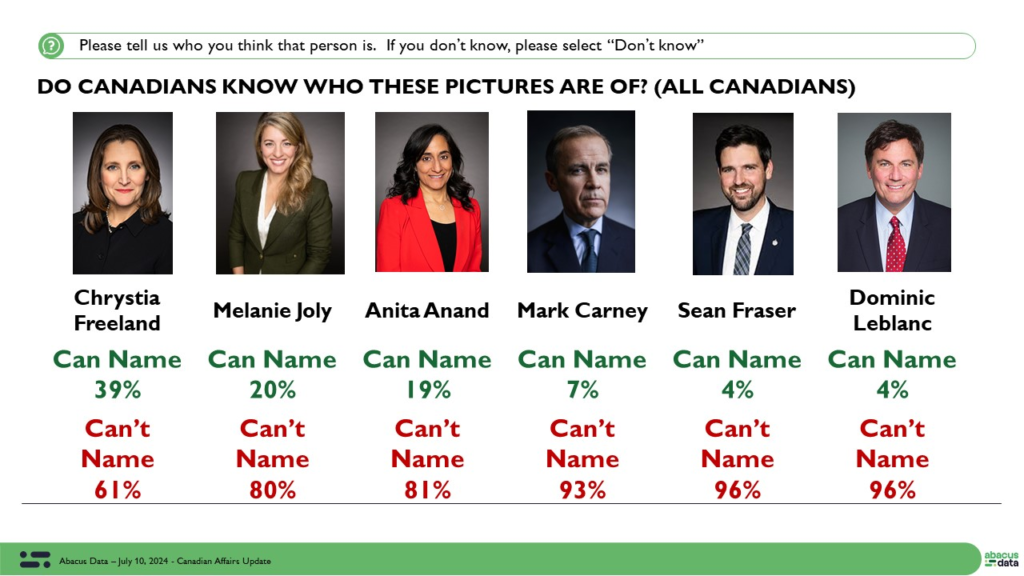
By the end of 2025, Mark Carney is not just Prime Minister. He is one of the most recognizable and, by several measures, trusted political figures in the country. Eighteen months earlier, almost no one could have predicted that outcome. In July 2024, only 7 percent of Canadians could identify him from a photograph. Even among Liberal supporters, recognition was barely 10 percent. Carney was respected in elite circles, but effectively invisible to most voters.
That invisibility turned out to be an asset.
At the time, Canadian politics was not suffering from a lack of options. It was suffering from exhaustion. Voters were not searching for novelty. They were searching for relief.
For much of 2023 and 2024, Canadians were living in what we described as a scarcity mindset: a persistent sense that life was getting harder to manage, more expensive, and less predictable. Scarcity is not just about prices. It is about control, or more precisely, the loss of it.

Scarcity is unforgiving to incumbents.
By late 2024, that dynamic had become unmistakable. After Chrystia Freeland resigned in December, just 12 percent of Canadians believed the Liberal government deserved re-election. When Justin Trudeau announced his resignation, Liberal support collapsed to 20 percent, trailing the Conservatives by 27 points, the largest gap Abacus Data had ever measured.
In that environment, familiarity was a liability. Continuity was a curse. Recognition often came bundled with resentment.
Carney’s obscurity insulated him from that backlash. He was not yet associated with failure, disappointment, or fatigue. He was not the solution, but he was not the problem either. In market terms, he was an unbranded product entering a category where most brands had become deeply unpopular.
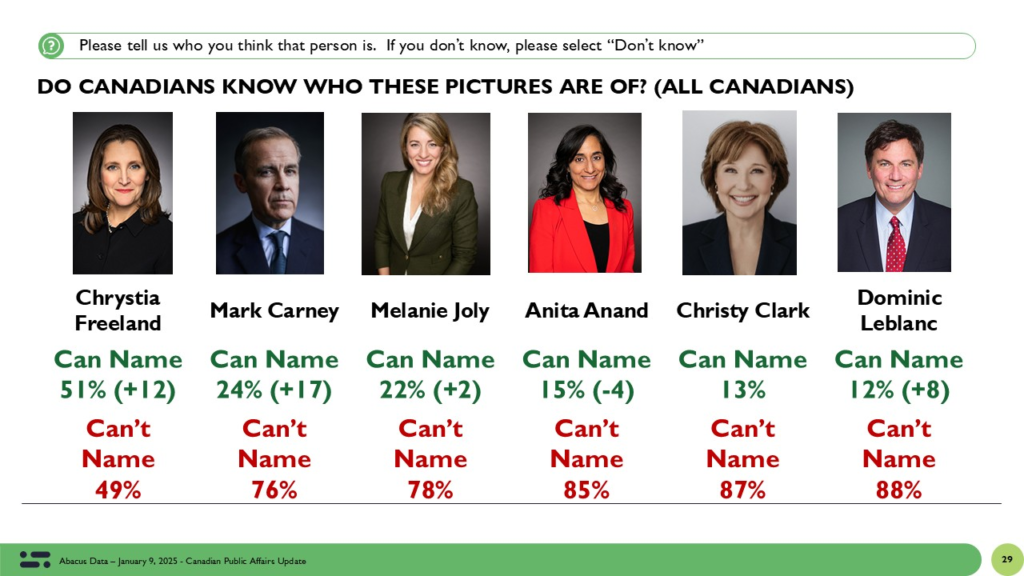
Between July 2024 and January 2025, Carney’s recognizability rose sharply, from 7 percent to 24 percent. This was not celebrity in the cultural sense. It was exposure driven by context. Canadians were watching a governing party unravel. Media attention shifted from governing to succession. Economic anxiety remained high. And the Liberal brand, especially Trudeau’s personal brand, had become so damaged that voters were actively scanning for something that looked competent without looking continuous.
Recognition alone does not move politics. Reaction does.
Among those who knew Carney, impressions were strikingly positive. In our January 2025 leadership testing, Carney posted the strongest net favourability of any potential Liberal leader among those familiar with him. Voters did not just notice him. They liked what they saw, especially relative to the alternatives.
Then the category itself changed.
Donald Trump’s election in November 2024 and his inauguration in January 2025 did more than introduce a foreign policy challenge. It reshaped the emotional context of Canadian politics. Scarcity did not disappear, but it was joined by something deeper and more destabilizing: precarity.
Precarity is not about prices. It is about stability. It is the fear that the systems you rely on might not hold. Trade access. Jobs. Economic sovereignty. National security. Canada’s ability to control its own fate in a harsher, less predictable world.
Trump’s rhetoric about annexation, his tariffs, and his unpredictability made those risks feel immediate rather than theoretical. And when the dominant emotional frame shifts, the market shifts with it.

This is where Carney’s offer fit the moment.
He was not selling empathy or cultural alignment. He was not selling disruption. He was selling reassurance through competence. “I know how these systems work. I have managed crises before. I can steady this.”
Abacus Data’s tracking showed government approval rising sharply after Carney assumed office, even though material conditions had not yet improved. What changed was not reality. It was who Canadians believed was capable of managing it.

Throughout the campaign, Carney’s comparative advantage over Pierre Poilievre was not ideological. It was positional.
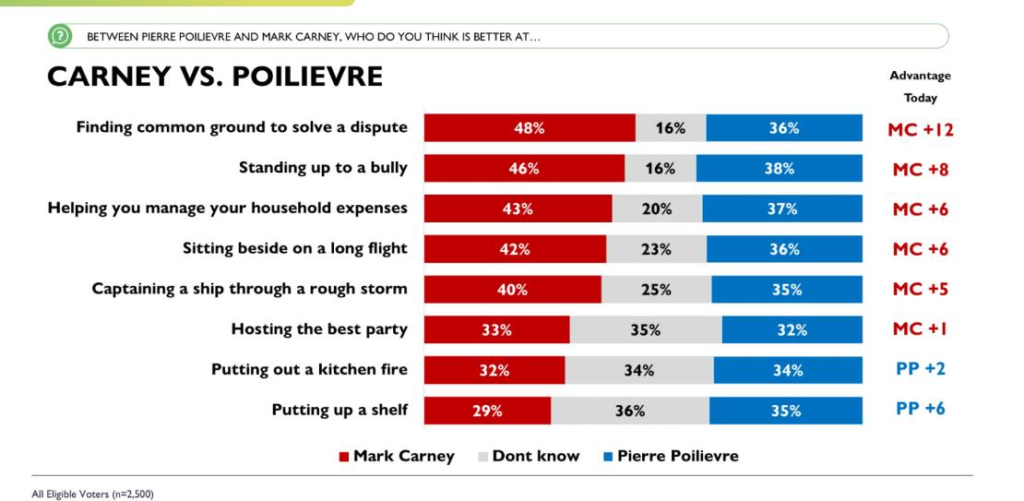
Poilievre dominated the market for disruption and change. Carney dominated the market for threat management and stability. When Canadians were asked who could best stand up to a bully or captain a ship through a bad storm, Carney consistently led. Those leadership attributes mattered enough to offset the Liberals’ incumbency disadvantage and the public’s still strong appetite for change.
The election result reflected that tension.
By election day, a majority of Canadians told us that change was their primary motivation, a dynamic that favoured the Conservatives. Yet Carney still captured roughly 30 percent of those change-motivated voters. That was the difference between a Liberal defeat and a Liberal comeback.
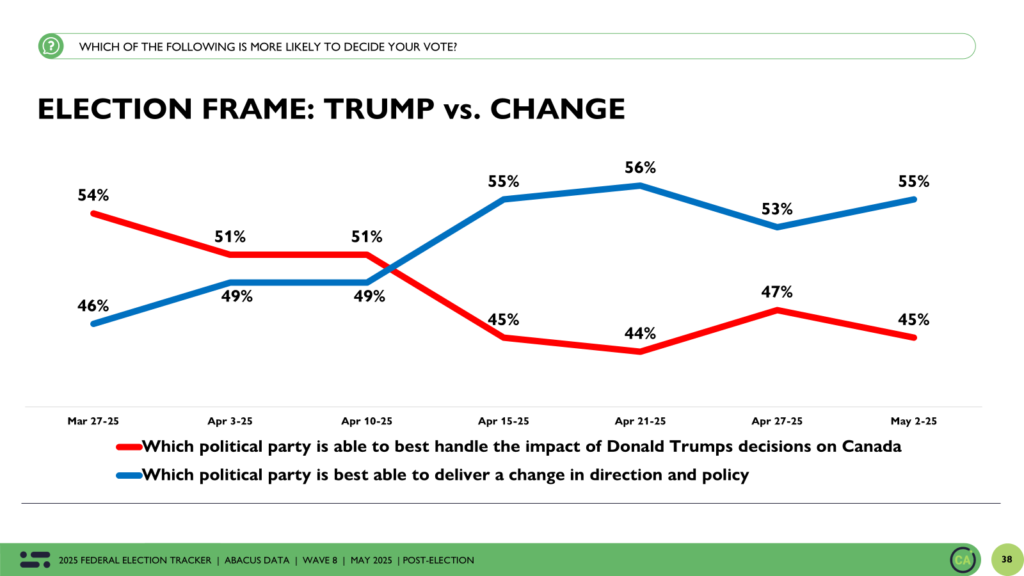
The victory itself was narrow, but the coalition behind it was revealing. Carney did not win because Canadians suddenly embraced Liberalism again. He won because enough voters, particularly older voters and those experiencing high precarity, decided that reassurance mattered more than disruption in that moment.
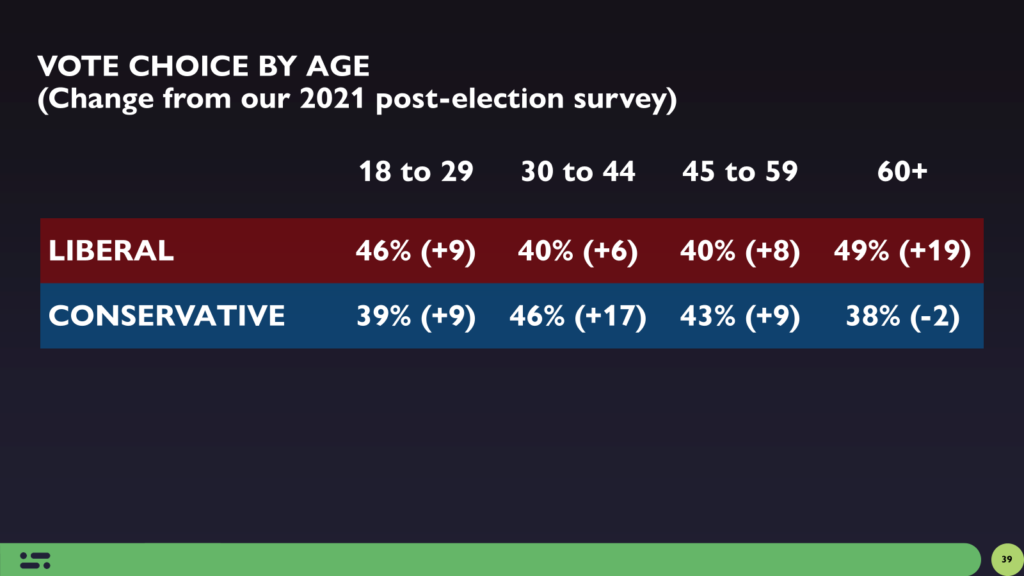
That generational divide persists.
At the end of 2025, Carney’s net favourability among Baby Boomers sits at +24. Among Gen X it is essentially neutral. Among Millennials it is negative. Gen Z is modestly positive. His coalition is anchored in voters who prioritize stability, institutional continuity, and risk management over relatability or cultural alignment.
This also explains why Carney’s brand feels solid, but not warm.
At the end of November, we asked Canadians an open-ended question: “How would you describe Mark Carney to a friend who does not follow politics?” The answers provide a revealing snapshot of both sides of the Carney brand.
Among those with a positive impression, the dominant portrait is remarkably consistent. Canadians describe him as smart, highly competent, and economically literate. Words like intelligent, capable, and knowledgeable appear repeatedly. Many anchor that competence explicitly in his financial background, describing him as a world-class economist, a former central banker, or someone who understands how the economy really works.
Just as important is temperament. Positive descriptions frequently include calm, steady, measured, pragmatic, and level-headed. People describe him as someone who thinks before he speaks, who does not overreact, and who brings discipline and seriousness to the role. Leadership is framed less as inspiration and more as stewardship.
Trust appears often, but in a specific form. Respondents talk about integrity, honesty, and principle, but not warmth. This is not a “he’s just like me” trust. It is “I believe he will do the right thing, even when it is hard.” In a precarity mindset, that is reassurance coded as competence.
There is also a noticeable contrast narrative. Many respondents describe him as a fresh start, different from Trudeau, and not a typical politician. His outsider status, despite his elite résumé, is interpreted as a lack of political baggage rather than detachment. For a meaningful segment, that “anti-politician” identity is central to his appeal.
But the same question also reveals the fault lines.
Among those with a negative impression, the critiques are not primarily about intelligence. Very few argue that Carney is unqualified. Instead, the dominant theme is distrust. He is described as dishonest, corrupt, self-serving, and acting in the interests of wealthy elites rather than ordinary Canadians. This is the core of negativity.
A second major cluster frames him as an elite or globalist figure, often sliding into conspiratorial language. References to global financial networks, outside control, or “WEF-style” influence are common. These responses are highly emotional and not policy-specific, but they are real and politically relevant. They speak to identity and suspicion rather than disagreement.
A third major theme is weakness. Many negative respondents describe Carney as spineless, too cautious, or not tough enough, especially when it comes to standing up to the United States and Donald Trump. This critique is notable because it appears both among opponents and among some otherwise positive respondents who wish he were more forceful.
Other negative themes reinforce this picture. He is described as out of touch with ordinary people, too similar to Trudeau, a banker unsuited to governing, or someone who talks more than he delivers. Complaints about affordability, deficits, immigration, and cost of living often attach to the broader “self-serving” frame rather than to specific policy objections.
Taken together, the open-ended data shows a sharply asymmetric brand. Support for Carney is grounded in competence, calm, and credibility. Opposition is grounded in distrust, elite suspicion, and questions about whose side he is on. That matters, because asymmetric brands are powerful but brittle. They rely on trust more than affection.
This framing is essential to understanding one of the central risks Carney now faces.
A significant part of his appeal rests on the fact that he does not feel like a conventional politician. His rise has been powered by an “anti-politician” brand: technocratic, serious, reluctant, and above the transactional manoeuvring many Canadians associate with Ottawa. He is seen less as someone who sought power and more as someone who accepted responsibility when circumstances demanded it.
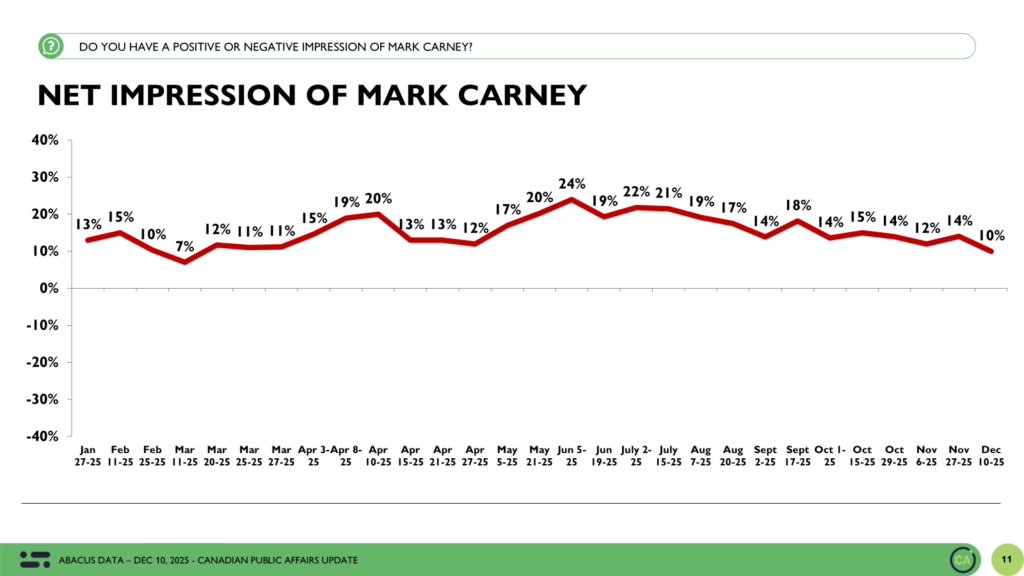
That perception is valuable. And it is fragile.
As we move into 2026, Carney governs in a Parliament where the arithmetic is tightening. Two Conservative MPs have already crossed the floor to sit with the Liberals. One more would be enough to secure a majority government without an election.
From a procedural perspective, this is entirely legitimate. Floor crossing is a long-standing feature of parliamentary systems.
But politics is not judged only by rules. It is judged by narrative.
For a leader whose brand is built on being different from politics as usual, overtly political acts aimed at consolidating power carry risk. Treat a floor crossing MP as a trophy, I think, challenges Carney’s brand. It looks bad and doesn’t reinforce his strengths. Moreover, encouraging or facilitating additional floor crossings to manufacture a majority could read as transactional and overly political, even if lawful. It risks blurring the differentiation that enabled his rapid rise.
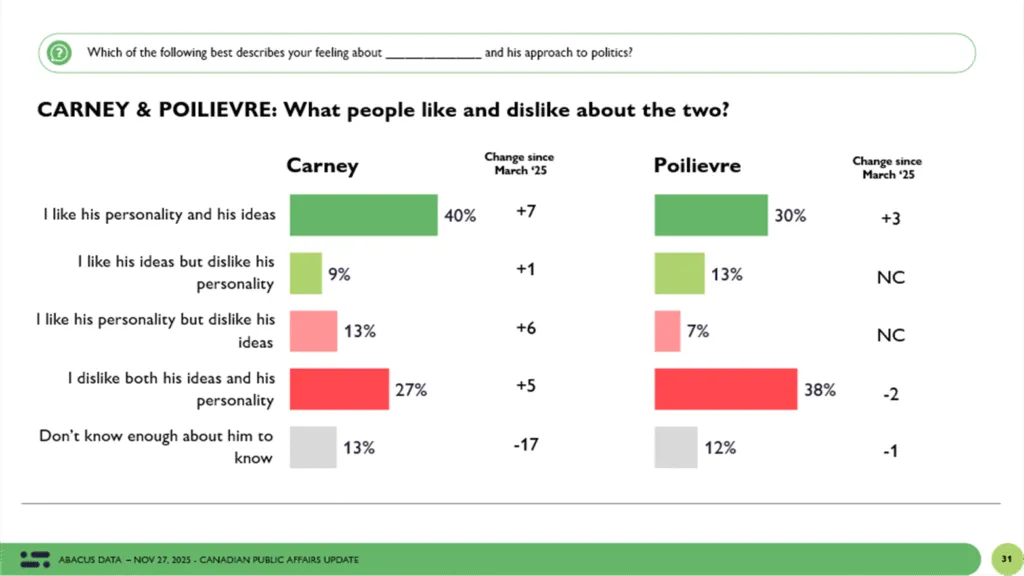
This is not because Canadians care deeply about parliamentary mechanics. It is because floor crossing activates a familiar script about ambition and power accumulation. That script runs directly against the emotional logic of Carney’s appeal.
The same tension applies to the possibility of a spring election. An election could be framed as a stabilizing move, seeking a clear mandate in a precarious moment and allowing the government to govern without constant election pressure. That framing aligns with his brand. But the risk is overreach. Consent sought openly reinforces trust. Power assembled quietly erodes it.
What Carney’s first year ultimately tells us is that Canadian politics today is less about ideology than orientation. Voters are not simply asking who best reflects them. They are asking who can keep the system from breaking and who can make life feel more predictable.
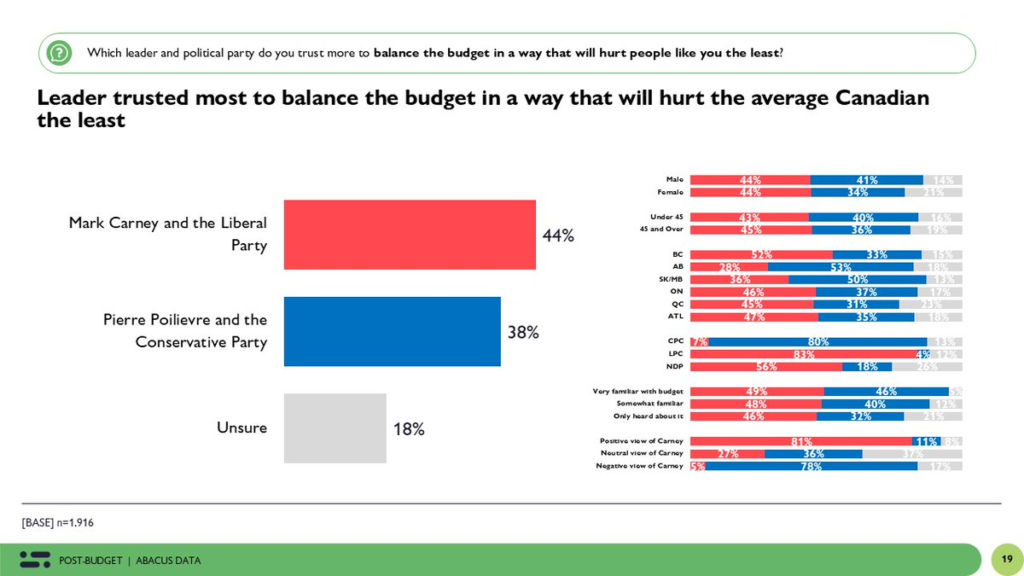
Carney’s rise from obscurity to the centre of gravity is a product of that question.
Whether he can remain there will depend on whether he can preserve the trust premium that lifted him, make competence visible to people still living with scarcity, and continue to act like the anti-politician in a system that constantly rewards political behaviour.
David Coletto is the founder & CEO of Abacus Data. Subscribe to his Subtack – inFocus with David Coletto – for more in-depth polling analysis you won’t find anywhere else.
About Abacus Data
We are the only research and strategy firm that helps organizations respond to the disruptive risks and opportunities in a world where demographics and technology are changing more quickly than ever.
We are an innovative, fast-growing public opinion and marketing research consultancy. We use the latest technology, sound science, and deep experience to generate top-flight research-based advice to our clients. We offer global research capacity with a strong focus on customer service, attention to detail, and exceptional value.
We were one of the most accurate pollsters conducting research during the 2021 Canadian election following up on our outstanding record in 2019.
Contact us with any questions
Find out more about how we can help your organization by downloading our corporate profile and service offering.