Ontario PCs Start 2026 in Front, But Appetite for Change Grows as Affordability and Health Care Define the Risk

January 14, 2026
Doug Ford and the Progressive Conservatives begin 2026 in a dominant position. Our latest survey finds the PCs continue to hold a wide lead on vote intention and remain the default choice for many Ontarians. But beneath that topline advantage, there is a building undercurrent of restlessness. Nearly half now say it is definitely time for a change in government, and on the issues that most shape daily life, Ontarians are far more likely to say things are headed in the wrong direction than the right one.

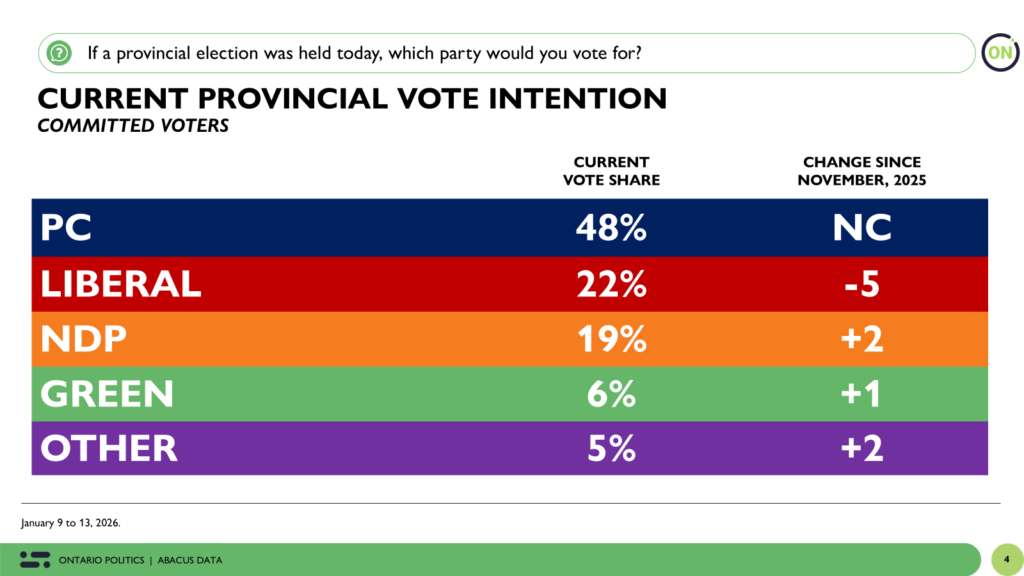
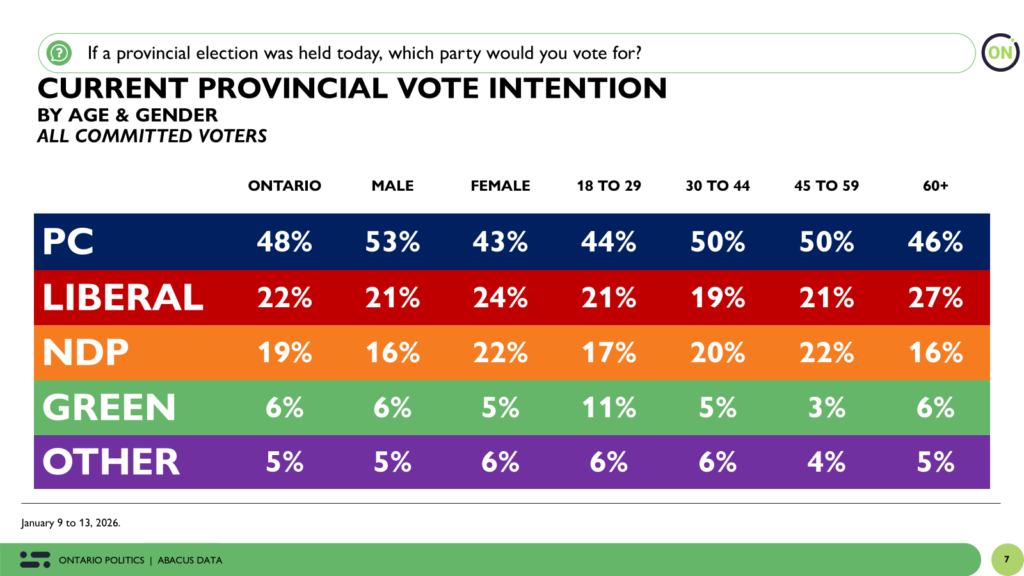
The Progressive Conservatives hold 48% among committed voters, essentially unchanged since late November. The Liberals are at 22%, down five points, while the NDP is at 19%, up two. The Green Party rises to 6% and 5% would vote for another party. This leaves Ontario politics with a familiar shape: a governing party still comfortably ahead, with the opposition fragmented and unable, so far, to convert public dissatisfaction into a clear alternative.
Voter Pools Suggest a Competitive Underlayer
One reason the opposition cannot be counted out entirely is that the consideration pools are more competitive than the ballot question. A slim majority of all Ontario adults, 51%, say they would consider voting Liberal, compared with 49% who would consider the PCs. Four in ten would consider voting NDP and 44% would consider the Greens. The governing party is still leading where it matters most, in committed support, but the broader market for votes is more open than the toplines suggest. The real question is whether anyone can organize that openness into momentum.
PCs Continue to Lead Across Regions and Demographics
The PCs lead across the province, including in Toronto, where they take 47% to the Liberals’ 28%. In the Greater Toronto and Hamilton Area, the PCs are at 49% with the Liberals at 23% and the NDP at 19%. In Southwestern Ontario, the PCs sit at 48%, with the Liberals and NDP essentially tied in the high teens, and the Greens notably stronger at 8%. In Eastern Ontario, the PCs are also at 48%, while the NDP edges ahead of the Liberals, 22% to 19%.

The PCs are stronger among men than women, 53% to 43%, but they lead across every age group. They are at 44% among those aged 18 to 29, 50% among those 30 to 44, 50% among those 45 to 59, and 46% among those 60 and older. The Liberals have their best age result among older Ontarians.
Government Approval Holds, But the Ceiling Looks Real
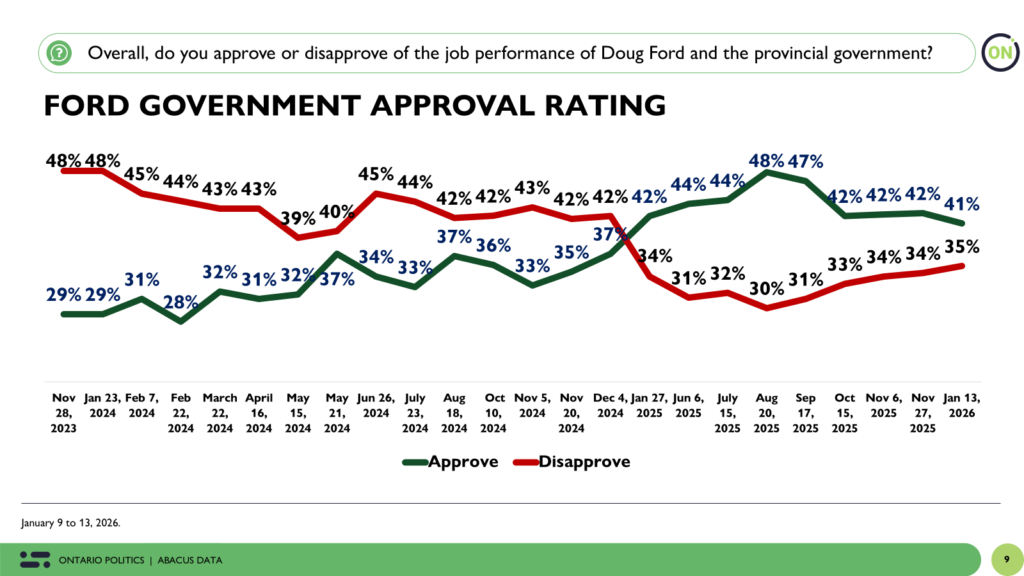
Approval of the Ford government is stable but not expanding. Four in ten approve overall, including 9% who strongly approve and 32% who mostly approve, for a combined approval of 41%, down one point since late November. Disapproval is at 35%, up one, while 20% neither approve nor disapprove. The government’s standing is not weak, but it looks capped and those who disapprove have increased by 5 points since August 2025.
Leader Impressions and Preferred Premier: Ford Still Leads, Opposition Still Searching
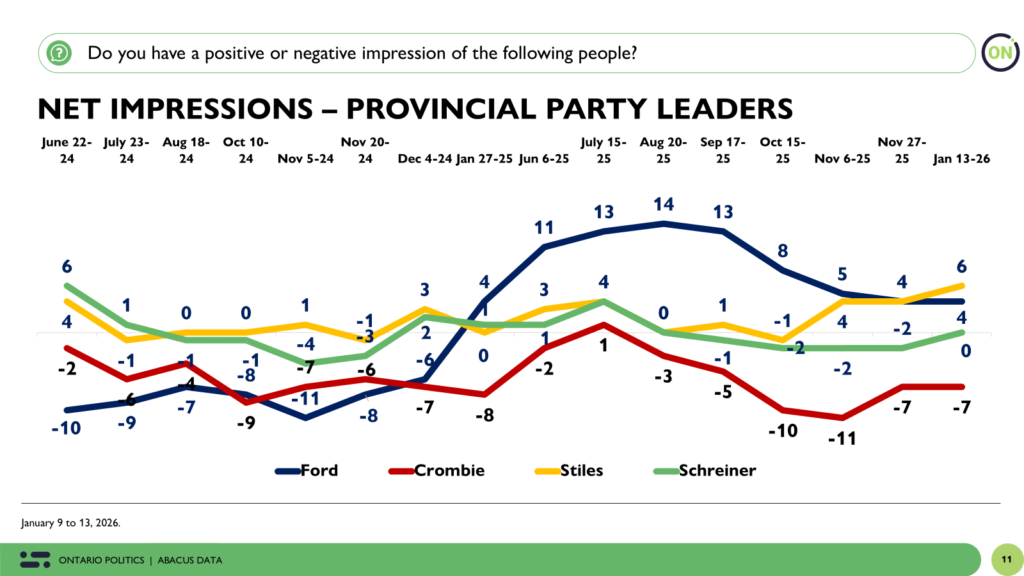
Doug Ford remains the best known and most competitive leader, with 40% holding a positive impression and 36% negative, for a net score of +4. Marit Stiles continues to have more upside than downside, with 29% positive and 23% negative, net +6, but she is less defined, with 15% saying they do not know enough to say. Mike Schreiner is even less defined, with two in five neutral and nearly one in five unsure, producing a net impression of zero.
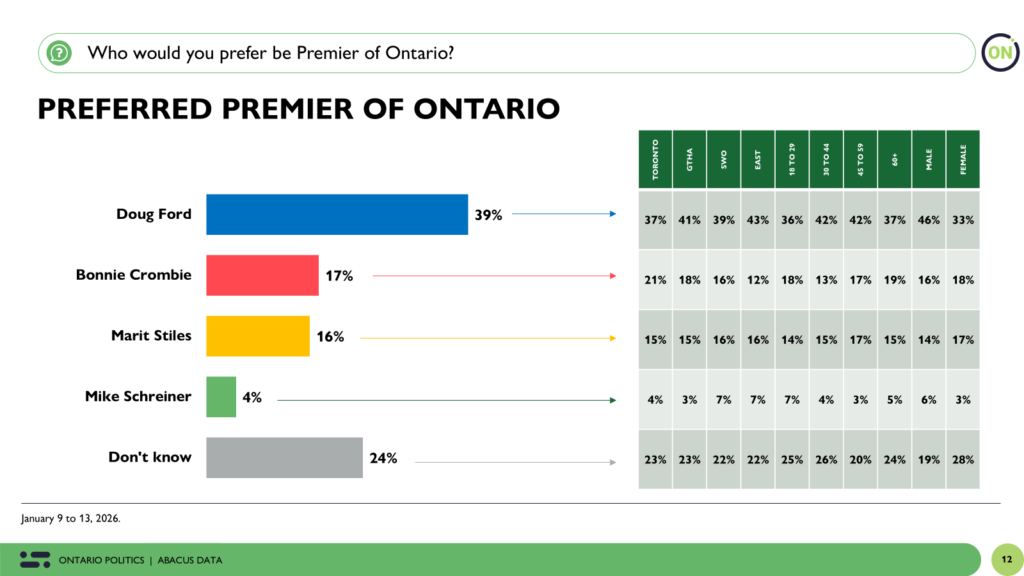
On preferred premier, Ford continues to lead, but not overwhelmingly. Four in ten pick Ford, while 17% choose Crombie and 16% pick Stiles. Only 4% choose Schreiner and nearly one quarter are unsure. This suggests Ford is still the default option, but the public is not locked into him either.
Desire for Change Rises, Even Without a Clear Alternative
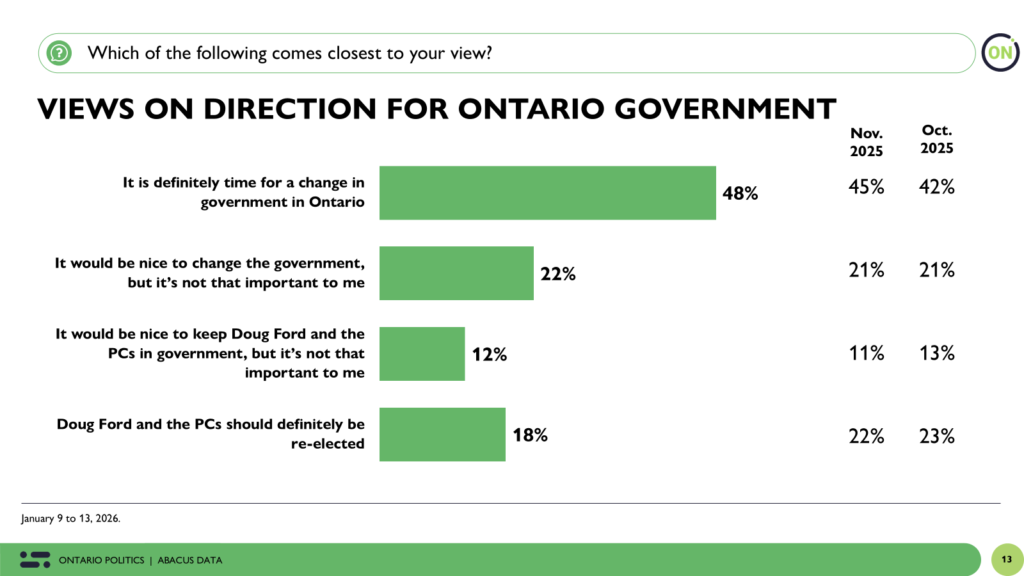
The most important political finding in this wave may be the direction question. Almost half, 48%, say it is definitely time for a change in government in Ontario (up 6 points since October). Only 18% say Ford and the PCs should definitely be re-elected. Another 22% say it would be nice to change the government but it is not that important to them, while 12% say it would be nice to keep the PCs but it is not that important.
This is a subtle but meaningful shift from the fall. The share saying it is definitely time for a change has risen from 42% in October to 45% in late November and now to 48%. At the same time, the group most firmly committed to re-electing the PCs has shrunk. The change sentiment is real, and it is growing, but it has not yet found a political home.
Policy Direction: The Minefields Are Clear
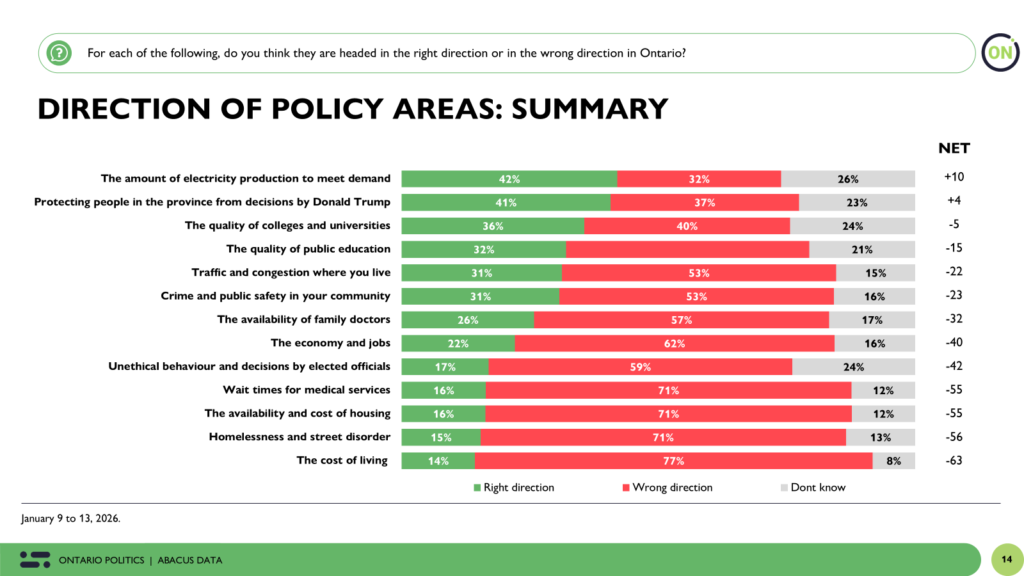
When Ontarians assess whether key issues are headed in the right or wrong direction, the map is stark. Only two areas have more people saying right direction than wrong direction: electricity production to meet demand and protecting people in the province from decisions by Donald Trump. Even there, the numbers are only modestly positive, and the public is far from unanimous. Everything else ranges from soft negatives to deep and punishing ones.
Public education is more decisively negative, and so are traffic and congestion and crime and public safety. The availability of family doctors and the economy and jobs are even more pessimistic, with large gaps between right and wrong direction. On ethics, wait times for medical services, housing affordability and availability, homelessness and street disorder, and the cost of living, the results are quite challenging. These are not marginal concerns. They are the core anxieties shaping how people experience Ontario, and the public is signalling that the province is moving in the wrong direction.
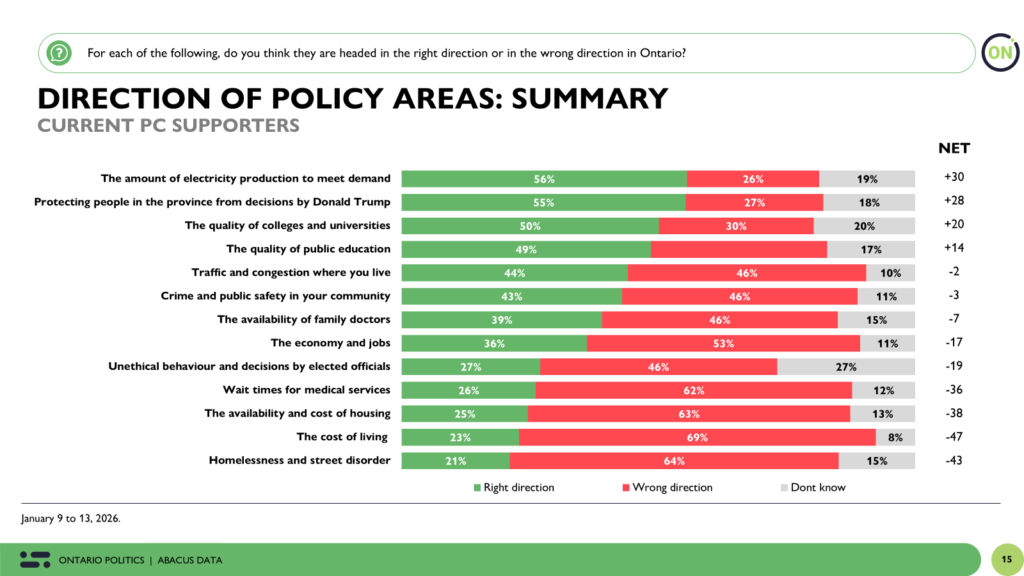
What is striking is how much of this concern exists even among current PC supporters. PC voters are optimistic about electricity supply and standing up to Trump, and they are relatively positive about education compared with the broader public. But on traffic, crime, family doctors, and the economy, PC supporters are not strongly positive. And on the affordability complex, housing, cost of living, homelessness, even PC supporters are negative. The governing coalition is holding, but it is not especially enthusiastic about the areas that most often decide elections.
Ford Government Impact: Credit Is Limited, and Blame Is Concentrated
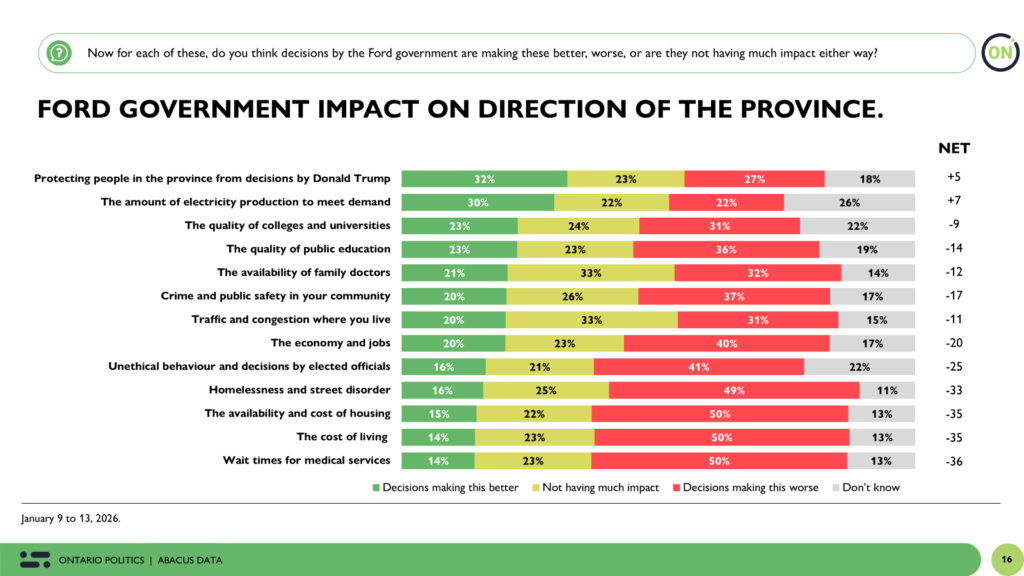
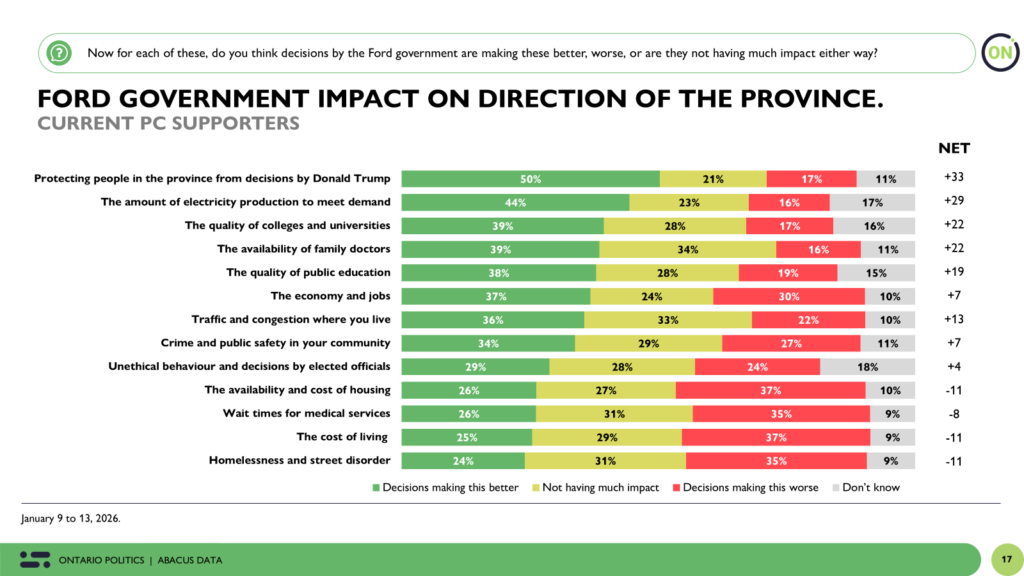
We also asked whether decisions by the Ford government are making each issue better, worse, or having little impact. Here the pattern becomes sharper. On electricity production and standing up to Trump, Ontarians are more likely to say the government is making things better than worse. These are the only areas where the government is in net positive territory.
Everywhere else, the government is net negative. Ontarians are more likely to say Ford government decisions are making public education, family doctor availability, crime and public safety, traffic and congestion, and the economy and jobs worse than better. That is already a problem because these are high salience issues. But the real danger zone is the affordability and health care cluster.
On housing affordability and availability, on the cost of living, on homelessness and street disorder, and on wait times for medical services, about half say the government is making things worse, and only a small minority say it is making things better. Even where many believe the government is not having much impact, the direction of blame is clear.
Again, the most revealing story is inside the PC base. Among current PC supporters, the government gets strong marks on standing up to Trump and managing electricity supply, and it is net positive on education and the economy. But even among those who would vote PC today, the government is net negative on housing, the cost of living, homelessness, and wait times. That is the definition of a minefield. These are issues that can erode support slowly and then suddenly, not because voters switch to an alternative enthusiastically, but because they become open to change when circumstances give them a credible reason to move.
A Flashpoint Issue: Crown Royal and Retaliation Politics
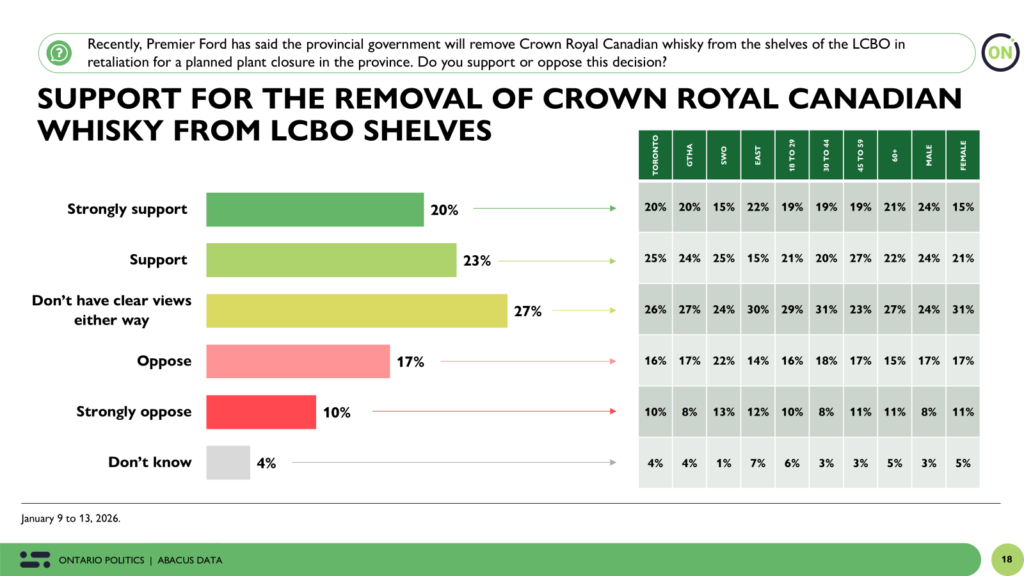
We tested one specific policy-style decision: removing Crown Royal Canadian whisky from LCBO shelves in retaliation for a planned plant closure. Ontarians are more supportive than opposed, with 43% in support compared with 27% opposed, but the largest single group is those without clear views either way at 27%.
This looks less like a polarizing wedge and more like an emerging cultural signal issue, one that Ford can use to communicate toughness and solidarity, but that has not yet hardened into a widely held opinion.

The Upshot
Ontario politics is beginning to wake up in 2026, but it is not yet moving.
Doug Ford continues to ride high in the only way that matters in a first-past-the-post system: he has a commanding lead on vote intention and he remains the preferred premier by a wide margin. The PCs are still the default choice for a large share of Ontarians, and the opposition is not offering a compelling counterweight.
The NDP remains stuck, still working to find relevance beyond its existing coalition, even as Marit Stiles posts a positive net impression. The Liberals, for their part, look like a party with potential but no clear vessel to carry it. With leadership uncertainty hanging over them and the Bonnie Crombie’s favourability under water, the path back is not simply about policy. It is about definition, credibility, and a sense that the party has turned a page.
At the same time, the risk for Ford is visible and it is growing. The desire for change is rising, and it is rising in a way that is not tethered to any one opposition party. Nearly half now say it is definitely time for a change, and that number has been climbing since the fall. That is not noise. That is a signal.
What keeps the government safe for now is that there is no alternative to Ford. Ontarians may be more dissatisfied with the direction of the province, but they are not yet persuaded that someone else would do better. A large undecided block on preferred premier is not just voter disengagement. It is suspended judgement.
And then there are the minefields, the policy arena where governments lose altitude.
On housing, cost of living, homelessness, and health care access and wait times, the public is not just pessimistic. It is leaning toward blaming the Ford government for making things worse.
Even PC supporters are not giving the government the benefit of the doubt on those issues. That the PC coalition is collapsing, but it does mean the PCs are increasingly governing over a landscape of unresolved problems with high emotional and financial stakes.
The most important political dynamic to watch in 2026 is whether the opposition can finally attach itself to the change mood, and whether Ford can prevent that by shifting the agenda to terrain that suits him.
Standing up to external threats, like Trump-era economic risk, and projecting competence on infrastructure and power supply are areas where he has room to manoeuvre. The affordability and health care file is where the danger lives. It is where perceptions are hardened, where progress is slow, and where mistakes are felt immediately.
Methodology
The survey was conducted with 1,006 eligible voters in Ontario from January 9 to 13, 2026. A random sample of panelists were invited to complete the survey from a set of partner panels based on the Lucid exchange platform.
These partners are typically double opt-in survey panels, blended to manage out potential skews in the data from a single source.
The margin of error for a comparable probability-based random sample of the same size is plus or minus 3.1 per cent, 19 times out of 20. The data were weighted according to census data to ensure that the sample matched Ontario’s population according to age, gender, educational attainment, and region. Totals may not add up to 100 due to rounding.
This survey was paid for by Abacus Data Inc.
Abacus Data follows the CRIC Public Opinion Research Standards and Disclosure Requirements.

About Abacus Data
We are Canada’s most sought-after, influential, and impactful polling and market research firm. We are hired by many of North America’s most respected and influential brands and organizations.
We use the latest technology, sound science, and deep experience to generate top-flight research-based advice to our clients. We offer global research capacity with a strong focus on customer service, attention to detail, and exceptional value.
And we are growing throughout all parts of Canada and the United States and have capacity for new clients who want high quality research insights with enlightened hospitality.
Our record speaks for itself: we were one of the most accurate pollsters conducting research during the 2025 Canadian election following up on our outstanding record in the 2021, 2019, 2015, and 2011 federal elections.
Contact us with any questions.
Find out more about how we can help your organization by downloading our corporate profile and service offering.