For 67% of Canadians, the cost of living feels as bad as it ever has
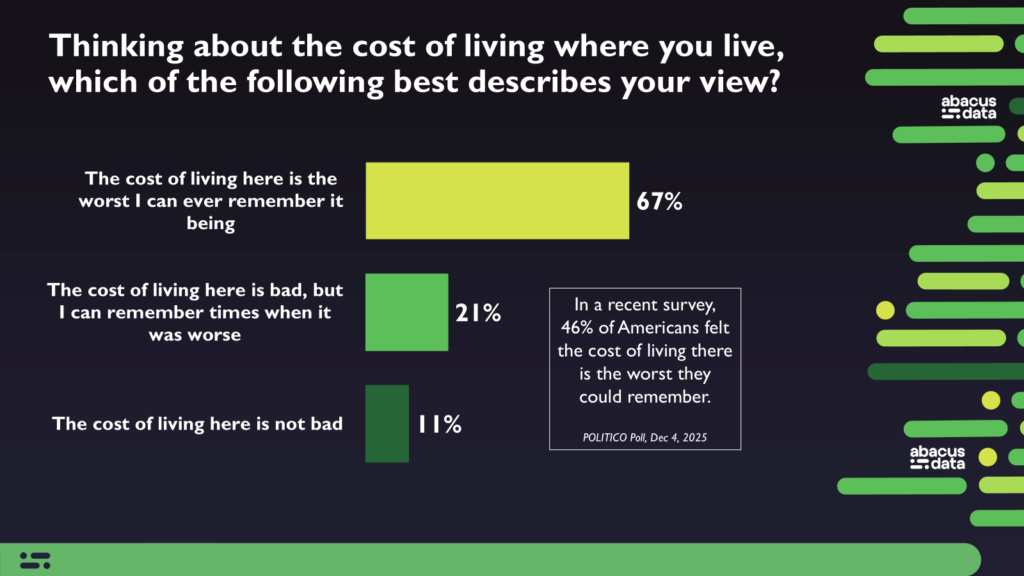
I noticed a really interesting question asked recently by POLITICO in the United States about the cost of living. It cut through the noise by asking people something very simple: does the cost of living today feel worse than ever, merely bad, or not bad at all? Given how central affordability has been to politics in Canada, I decided to replicate the question here.
The results underline just how dominant this issue remains in the lives of Canadians.
Fully 67% of Canadians say the cost of living where they live is the worst they can ever remember it being. Another 21% say it is bad, but that they remember times when it was worse. Just 11% say the cost of living is not bad. In the United States, 46% of Americans recently said the cost of living was the worst they could remember, suggesting Canadians are feeling this pressure even more acutely.
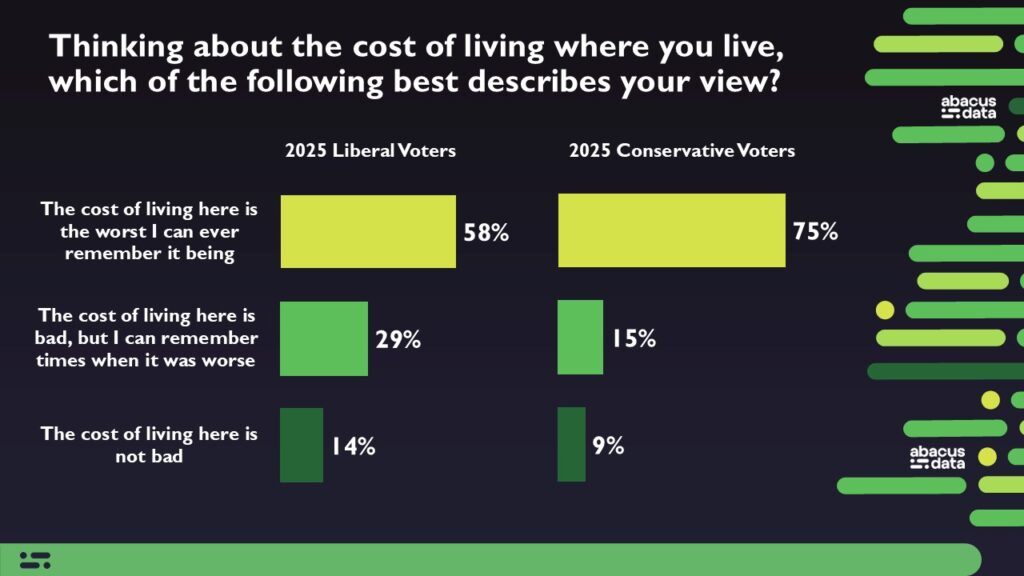
There is a clear partisan gap in how acute these affordability pressures feel. While a majority of Liberal voters say the cost of living is the worst they can remember, that view is far more widespread among Conservative voters, where three quarters describe current conditions in those stark terms, compared with 58% of Liberals, underscoring how cost-of-living anxiety is both broad and more intensely felt on the Conservative side of the electorate.
This is not a marginal concern or a background anxiety. It is a dominant lived experience that continues to shape how Canadians interpret government performance, leadership, and competing policy priorities, alongside concern about Donald Trump, trade, and global instability.
Cost of living dominates the public agenda
When Canadians are asked to identify the top three priorities for the federal government right now, the rising cost of living stands clearly above every other issue. Nearly two thirds select it, far ahead of the economy, housing affordability, healthcare, or concerns about Trump and his administration.
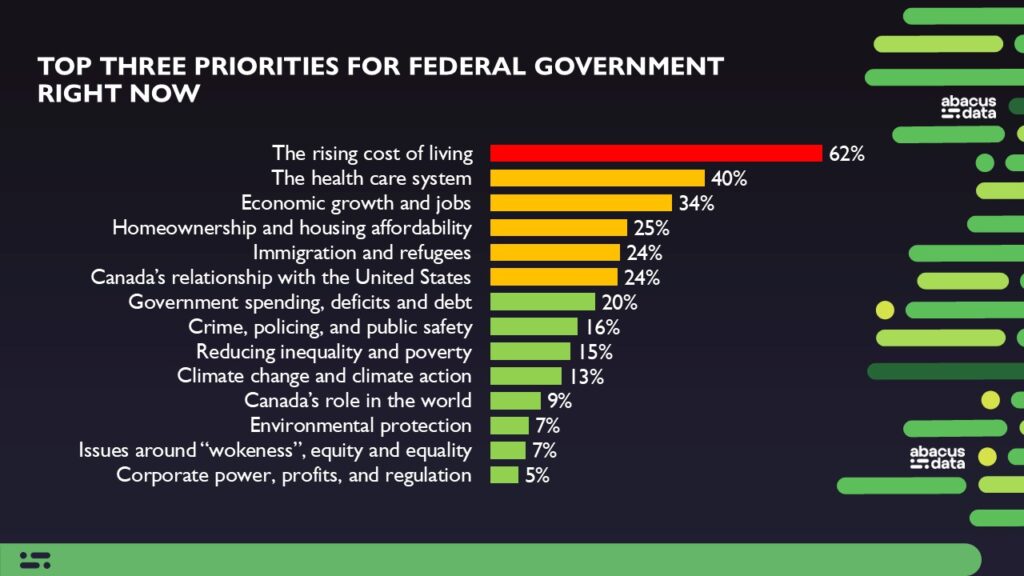
This finding is remarkably consistent across regions and age groups. In Atlantic Canada, Ontario, the Prairies, Quebec, and British Columbia, affordability ranks first. Among younger and older Canadians alike, it anchors the issue agenda, even as it is paired with different secondary concerns.
For organizations engaged in public affairs and advocacy, this context matters. Any policy conversation, regardless of its primary focus, is now being interpreted through an affordability lens. Issues that are not explicitly about the cost of living are still being evaluated on whether they add pressure, provide relief, or feel disconnected from the financial reality many households are navigating.
What Canadians mean when they talk about affordability
Canadians are not speaking in abstractions when they talk about the cost of living. They are responding to very specific pressures.
The most widely cited concern is grocery prices, selected by 81% of Canadians. This concern rises sharply with age, from 61% among those aged 18 to 29 to 93% among those aged 60 and over. Food prices are the most universal and emotionally resonant cost because they are unavoidable and visible every week.
Housing costs, including rent, mortgage payments, and home prices, are the second most cited concern at 50% overall. Here the generational divide is clearer. Six in ten Canadians under 30 cite housing as a major pressure, compared with fewer than four in ten among those aged 60 and over.
Other costs matter, but to a lesser degree. Utility bills, household goods, healthcare expenses, transportation, insurance, and debt payments all register. Among younger Canadians, education expenses stand out more, while healthcare costs rise in importance among older Canadians.
While affordability is a shared concern, what people mean by affordability varies by life stage. Messages that treat the cost of living as a single problem risk missing the specific pressure points that different audiences feel most acutely.
Who prioritizes the cost of living most
The rising cost of living is identified as a top priority across regions, but it is especially pronounced in Atlantic Canada and Ontario. In every region, however, it ranks first.
Age differences are modest in incidence but meaningful in interpretation. Majorities in every age group say affordability should be among the federal government’s top priorities. Younger Canadians are more likely to pair it with housing affordability, while older Canadians are more likely to link it with healthcare and Canada’s relationship with the United States.
Gender differences also emerge. Women are more likely than men to cite the rising cost of living as a top priority and more likely to associate it with housing and healthcare. Men are somewhat more likely to connect affordability to economic growth, jobs, and government spending.
The political impact is real, but not yet decisive
The political consequences of affordability concerns are visible, but they are not yet fully crystallized.
Among Canadians who say the cost of living is a top issue for them, vote intention favours the Conservatives at 44%, with the Liberals at 38% and the NDP at 8%.
Government approval also shifts. Among those who prioritize the cost of living, 41% approve of the government’s performance, 20% are neutral, and 39% disapprove. Among everyone else, approval rises to 57%, with disapproval falling to 28%.
The same pattern appears in impressions of Prime Minister Mark Carney. Among those who prioritize the cost of living, his net impression is narrowly positive at +2, with 40% positive and 38% negative. Among everyone else, his net impression rises sharply to +20, with 52% positive and 30% negative.
These gaps matter. They show that affordability concerns are associated with weaker approval and softer personal ratings. At the same time, they also show that the issue has not yet become a defining political liability for the Carney government.
Why affordability has not yet broken through politically
There are several reasons why the cost of living, despite its intensity, has not yet fully translated into a political breaking point.
Many Canadians see affordability as structural and global rather than the result of a single government’s decisions. That tempers blame, even as frustration remains high.
The Carney government has taken some steps to demonstrate it is sympathetic about the issue. It eliminated the carbon price, cut income taxes, made the national school food program permanent, and launched automatic tax filing for lower income Canadians to ensure they can access government benefits.
Affordability is also competing with other anxieties rather than crowding them out. Trump, trade, healthcare, and global instability are layered on top of cost pressures, creating a complex agenda rather than a singular referendum that may be uniquely Canadian.
Why the next few months matter
Timing may shift the dynamics.
The holiday season is now upon us, a period when spending increases even for households under strain. That will be followed by January, when credit card bills arrive, savings feel thinner, and the post-holiday financial squeeze sets in.
This seasonal pattern has the potential to intensify affordability concerns in the first few months of the new year. For governments, institutions, and advocacy organizations alike, this is a moment when empathy, tone, and relevance will matter more than ambition or abstraction.
Implications beyond electoral politics
The findings also carry clear implications for associations, corporations, and non-profits shaping advocacy agendas.
Affordability has become a credibility test. Audiences are filtering messages through their own financial stress, and proposals that do not clearly connect to household impact risk being dismissed as out of touch.
For business and industry groups, arguments about growth, competitiveness, or innovation will resonate only if they are explicitly linked to stability, predictability, and cost relief for consumers or workers. I wrote about connecting the macro to the micro this summer.
For non-profits and civil society organizations, public support for social investment, climate action, and equity remains, but it is increasingly conditional. Canadians want to understand how these priorities fit into an already strained financial landscape.
Across sectors, effective advocacy in the coming year will require acknowledging the pressure people are under, demonstrating how solutions reduce risk rather than add to it, and being honest about trade-offs.
For now, the cost of living remains a warning light rather than a red light for the Carney government. But the intensity of feeling, combined with seasonal pressures and fragile household finances, means the issue is unlikely to fade quietly into the background.
Methodology
The survey was conducted with 1,500 Canadians from December 5 to 9, 2025. A random sample of panelists were invited to complete the survey from a set of partner panels based on the Lucid exchange platform. These partners are typically double opt-in survey panels, blended to manage out potential skews in the data from a single source.
The margin of error for a comparable probability-based random sample of the same size is +/- 1.53%, 19 times out of 20.
The data were weighted according to census data to ensure that the sample matched Canada’s population according to age, gender, and region. Totals may not add up to 100 due to rounding.
This poll was paid for by Abacus Data

About Abacus Data
We are the only research and strategy firm that helps organizations respond to the disruptive risks and opportunities in a world where demographics and technology are changing more quickly than ever.
We are an innovative, fast-growing public opinion and marketing research consultancy. We use the latest technology, sound science, and deep experience to generate top-flight research-based advice to our clients. We offer global research capacity with a strong focus on customer service, attention to detail, and exceptional value.
We were one of the most accurate pollsters conducting research during the 2021 Canadian election following up on our outstanding record in 2019.
Contact us with any questions
Find out more about how we can help your organization by downloading our corporate profile and service offering.