Abacus Data New Brunswick Poll: 79% Comfortable with Paramedics Playing Greater Role in Healthcare


December 1, 2025
Findings from new research conducted by Abacus Data for the Paramedic Association of New Brunswick (PANB).
A new province-wide survey conducted by Abacus Data for the Paramedic Association of New Brunswick shows overwhelming support for giving paramedics a greater role in delivering healthcare in the province.
From October 24 to 30, 2025, Abacus Data surveyed 600 residents through our New Brunswick Omnibus survey to find out how New Brunswickers currently see paramedics and what role they want them play in creating a stronger, more resilient, and patient-focused health system.
The findings show that large majorities not only trust paramedics to deliver a high standard of care, but are also are open to seeing them working alongside doctors and nurses in more healthcare settings, such as emergency departments and primary care clinics.
The research confirms: New Brunswickers trust paramedics and giving them greater responsibility has the potential to not only improve patient care but also relieve pressure from other healthcare professionals and stabilize the whole system.
The full results are provided below.

Lead high-impact public affairs and consumer research at Abacus Data, guiding clients with insight and storytelling. We are seeking a seasoned research consultant and strategic advisor ready to own relationships
and growth.
Not Seeing or Feeling Progress on Healthcare
Like those living in other parts of Atlantic Canada and across the country, New Brunswickers want more, and better, access to healthcare. They are frustrated by primary care shortages as well as long wait times for surgeries; and many think emergency departments are understaffed, overcrowded, and busting at the seams, with bad ED stories often in the news and circulating online.
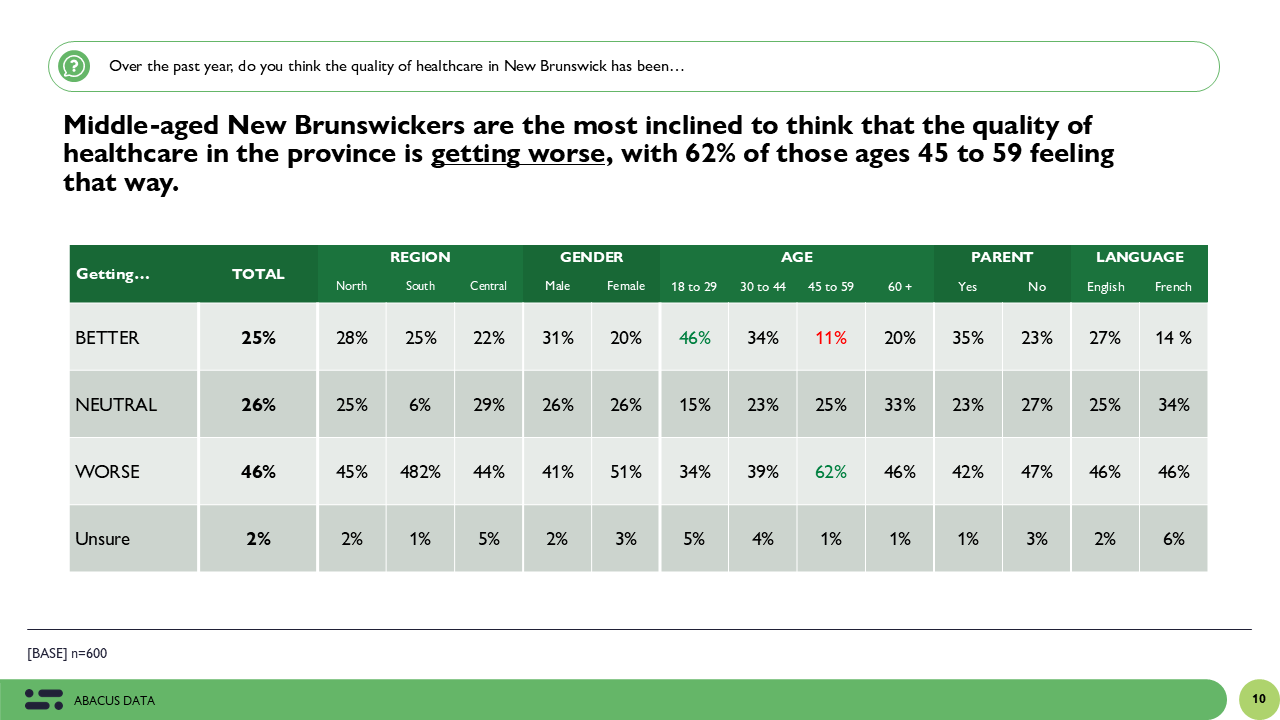
They also don’t see much progress on improving healthcare. When asked if they think the quality of care in the province has improved, stayed the same, or worsened over the past year, the most common answer is worsened, with slightly less than half of the population (46%) choosing that option, and just one-quarter (25%) saying its “getting better.”
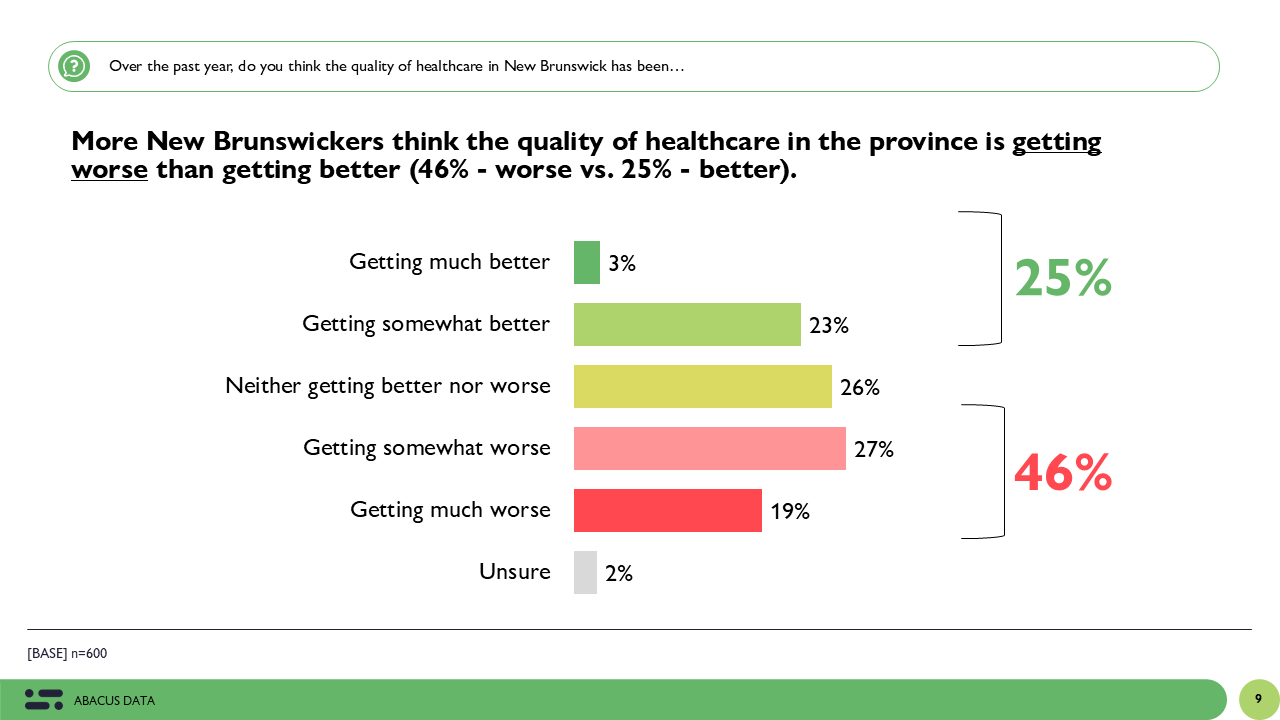
Thinking that healthcare in the province is getting worse, not better, is a common experience with New Brunswickers of all regions and backgrounds tending to feel that way.
However, some segments are more likely than others to think things are getting worse.
62% of those ages 49 to 59 think the quality of the care is declining – a higher proportion than in other age groups.
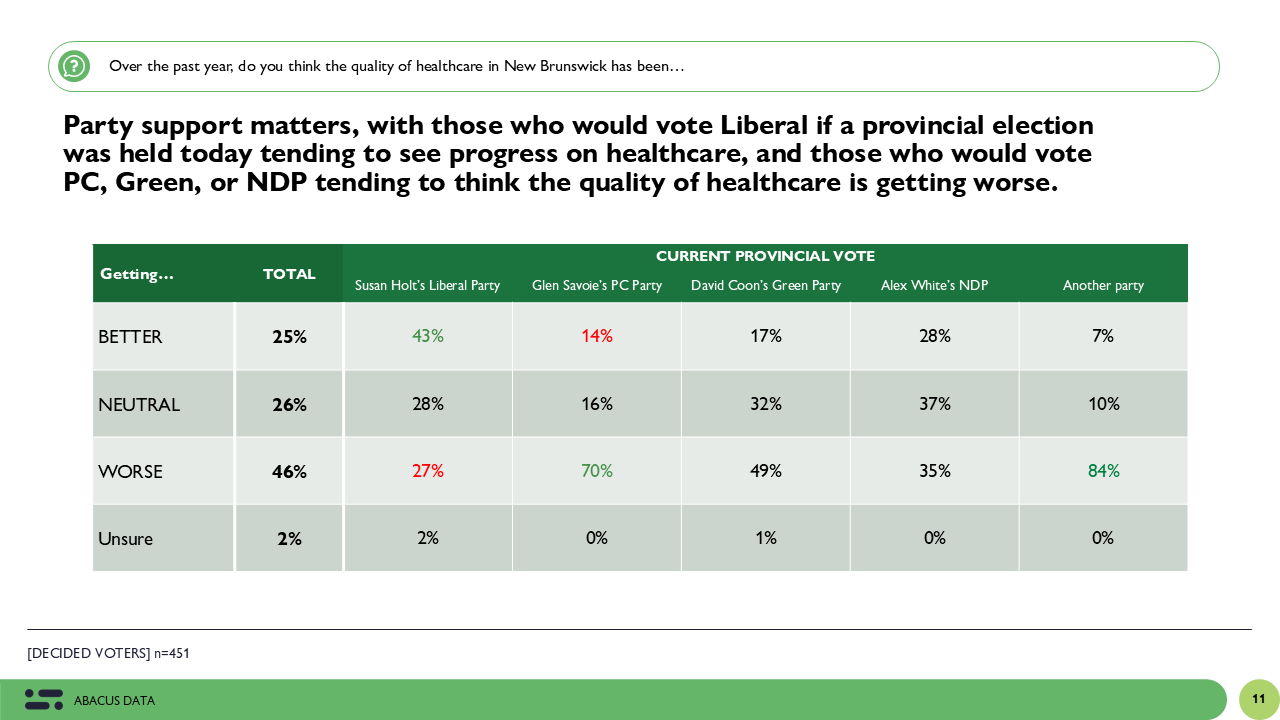
Provincial party support also matters, with those who say they would vote PC (70%) if a provincial election was held today being much more likely to think the quality of care is getting worse than current Green (49%), NDP (35%), and Liberal (27%) voters.
Paramedicine = A Bright Spot in a System Under Pressure
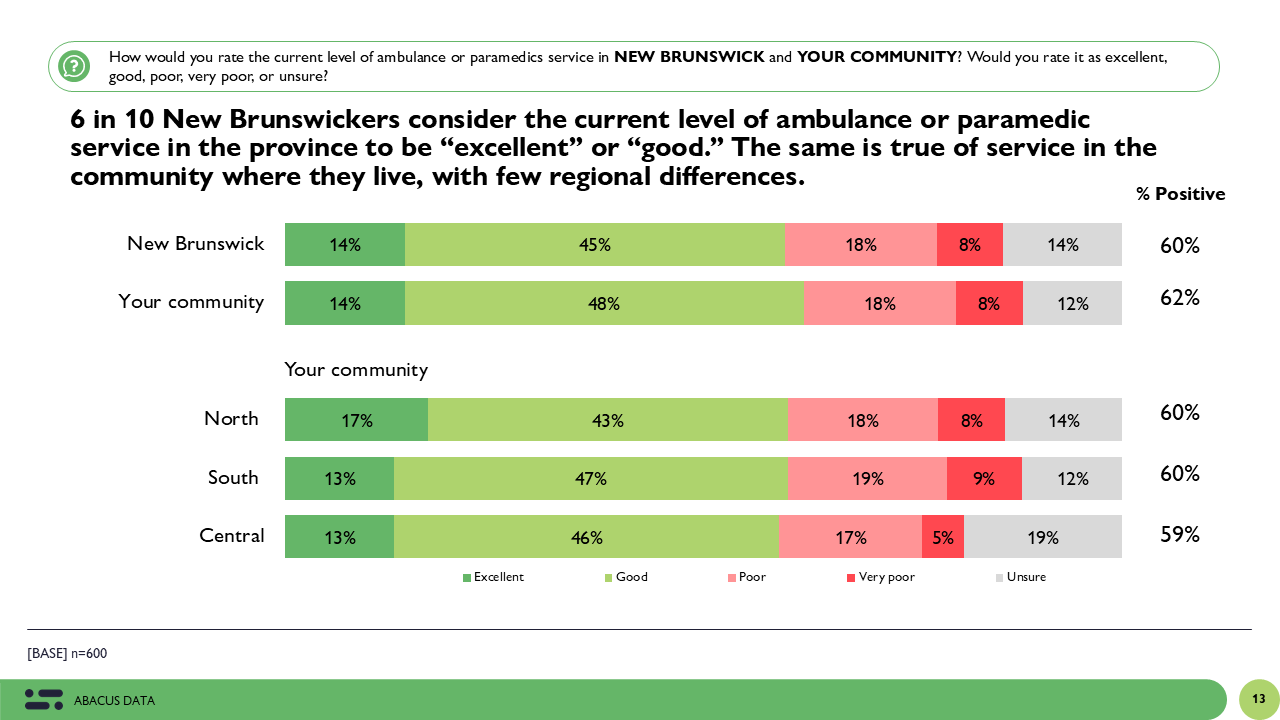
While many are critical of the current state of the provincial health system, New Brunswickers do not see paramedicine as a weak point. In fact, they see it as one of the few elements of the system that is performing well.
60% currently rate paramedic and ambulance services in the province as “excellent” or “good” and about the same proportion (62%) rate the quality of services in the place where they live as “excellent” or “good,” with few regional differences.
This stands, of course, in sharp contrast to how New Brunswickers are currently feeling about the state of New Brunswick’s healthcare system, with those frustrations boiling over.
Paramedic and Ambulance Ratings Mostly Positive Over Time
We also have some historic data to compare against these new numbers.
Our previous research, dating back to 2018, shows that New Brunswickers have consistently rated the quality of paramedic and ambulances services more positively than negatively.
- In 2023, 75% of New Brunswickers rated the quality of paramedic and ambulance services in their community as being “excellent” or “good.”
- In 2021, 81% rated the quality of service as “excellent” or “good.”
- And in 2018, 73% scored it as “excellent” or “good.”
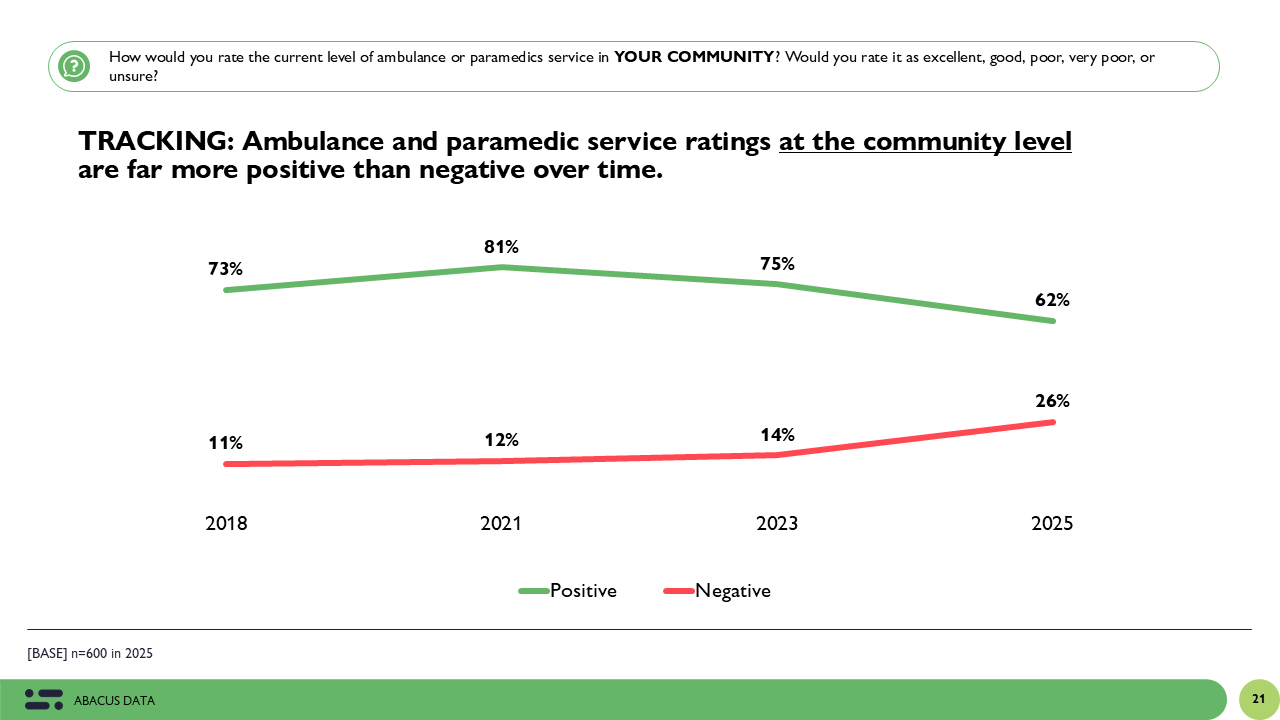
While current paramedic-and-ambulance-service ratings are a little bit lower now than they were in the past, far more people continue to rate the level of service in their community positively than negatively (i.e. 62% as “excellent” or “poor” compared to 26% as “poor” or “very poor”) this fall and over time.
Paramedics Deeply Trusted
Trust is essential in healthcare, and paramedics also score well in this area, continuing to rank near the top of the trust-in-healthcare-professionals list.
When asked how much they trust in various health professionals to make on-the-spot decisions, New Brunswickers place paramedics slightly behind doctors and nurse practitioners, but not by much of a difference (only 6 and 3 pts, respectively).
This fall, 73% of New Brunswickers give paramedics a rating of 7 or more out of 10 on the trust scale compared to 79% for doctors and 76% for nurses.
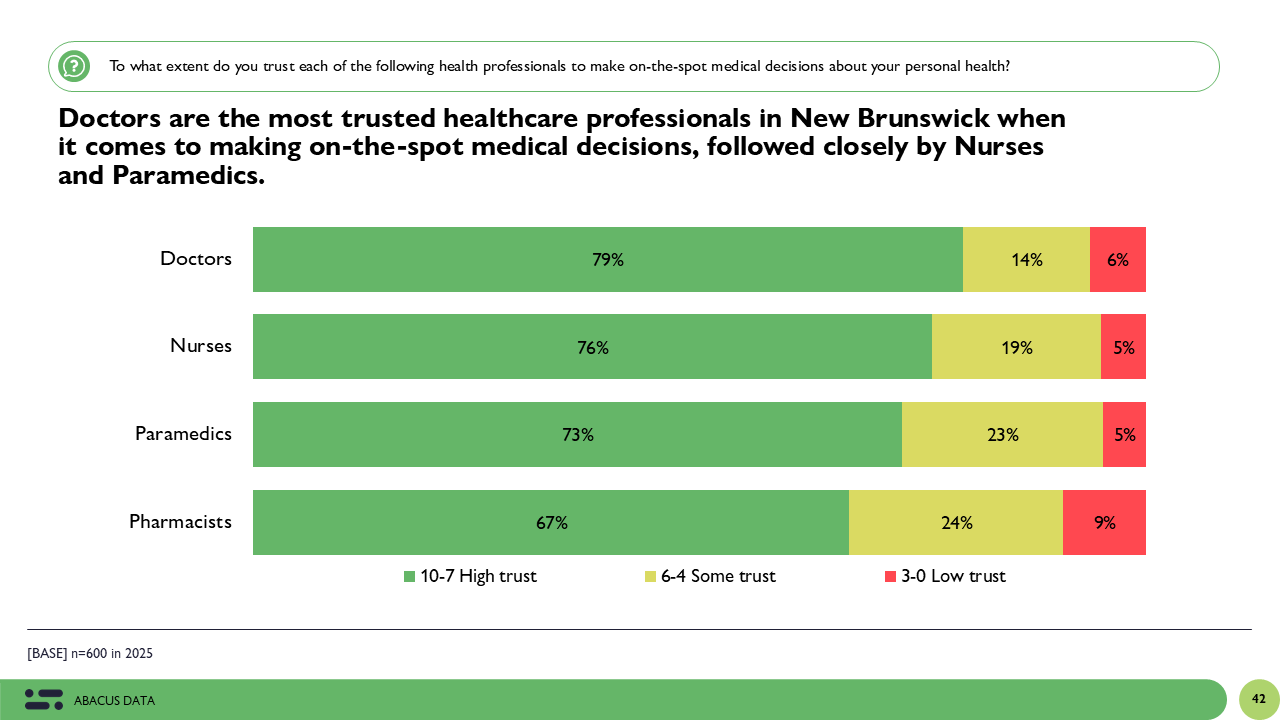
These results further demonstrate the high degree of personal confidence New Brunswickers have in paramedics, clearly seeing them as highly trained professionals with the kind of medical knowledge and decision-making skills they can rely upon.
Whereas there was once a time when paramedics were seen as being much less skilled or experienced than other healthcare professionals, that is no longer the case.
In 2025, paramedics are highly valued – as is the role they play in a system under strain.
79% Comfortable with Paramedics Doing More
In addition to thinking differently about who paramedics are and the value they bring to health care teams, very high proportions are also open to paramedics playing a greater role in the province’s health care system.
This fall, an overwhelming majority – 79% of all New Brunswickers – say they are comfortable with the idea of paramedics playing a greater role in delivering healthcare in the province and their home community, with much smaller groups objecting.
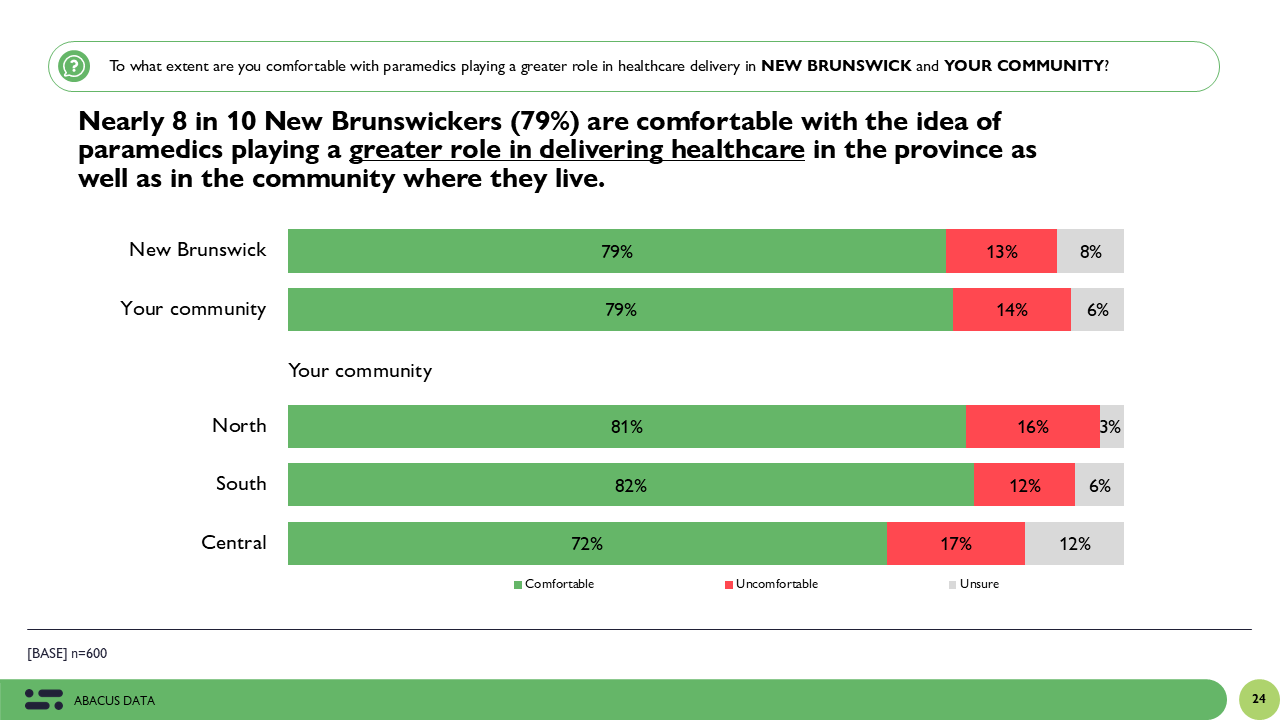
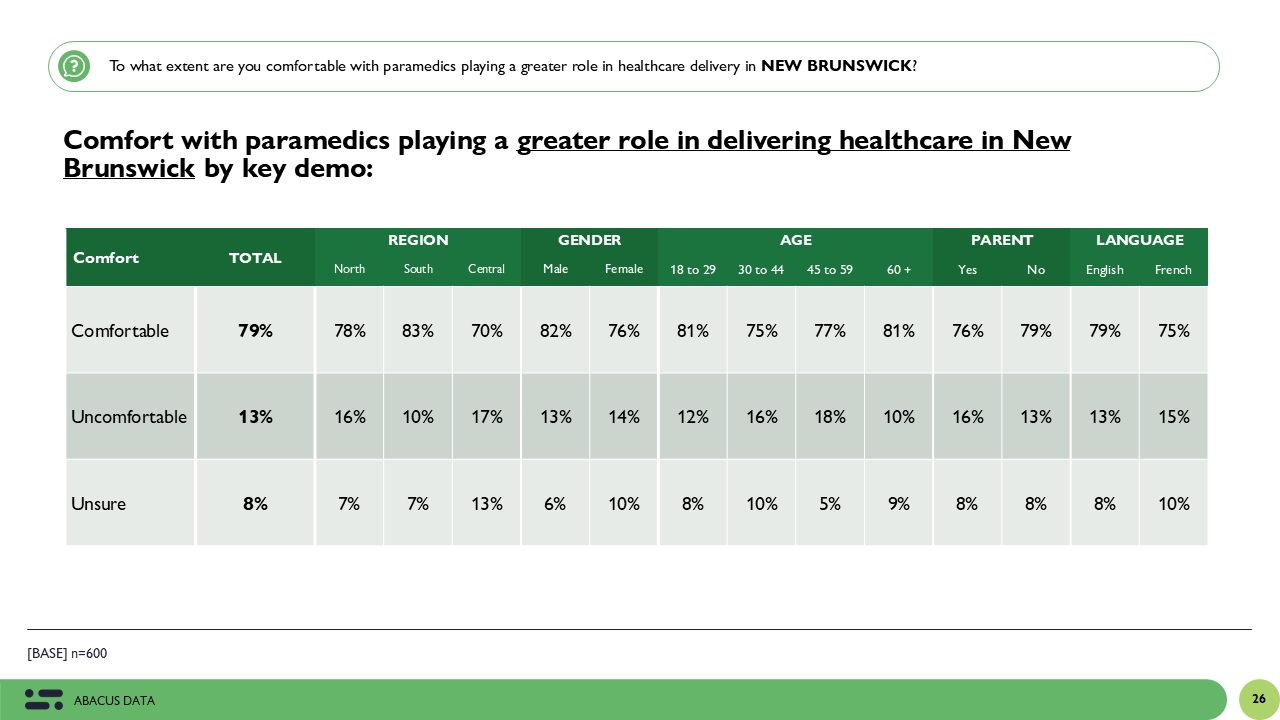
This support is broad-based, with few regional or demographic differences in the results.
Comfort cuts across age, region, linguistic, and gender lines, ranging from the low 70s to low 80s in each segment.
Party support also makes little to no difference, with current NDP (92%), Green (85%), and Liberal (84%) voters only being slightly more comfortable with the idea of paramedics playing a greater role in delivering healthcare in New Brunswick than PC (74%) voters.
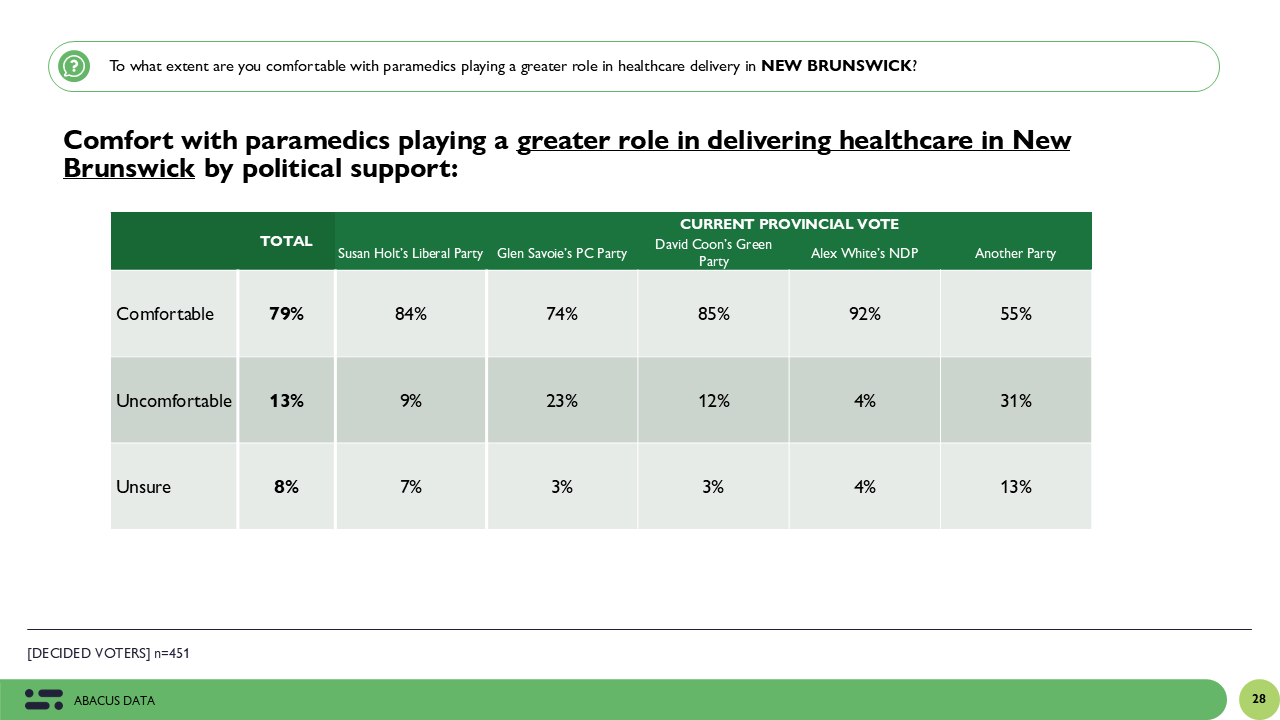
In today’s day and age, this kind of political consensus is rare.
It further highlights the safe ground the Holt government would be on if they decided to expand the role of paramedics.
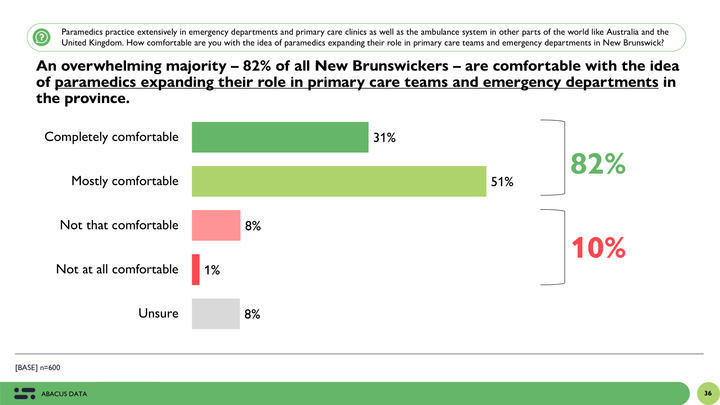
82% Open to Expanded Role on Primary Health Teams and in EDs
To go even deeper, we also asked New Brunswickers how comfortable they would be with paramedics specifically having a greater role working on primary care teams and in emergency departments.
The results here are even more conclusive.
A remarkable 82% of New Brunswickers say they are open to paramedics serving in those healthcare settings as is commonly done in other parts of the world like the United Kingdom and Australia.
That’s an extremely high rate of acceptance.
And only 10% – of all New Brunswickers – say they would be uncomfortable with such a change.
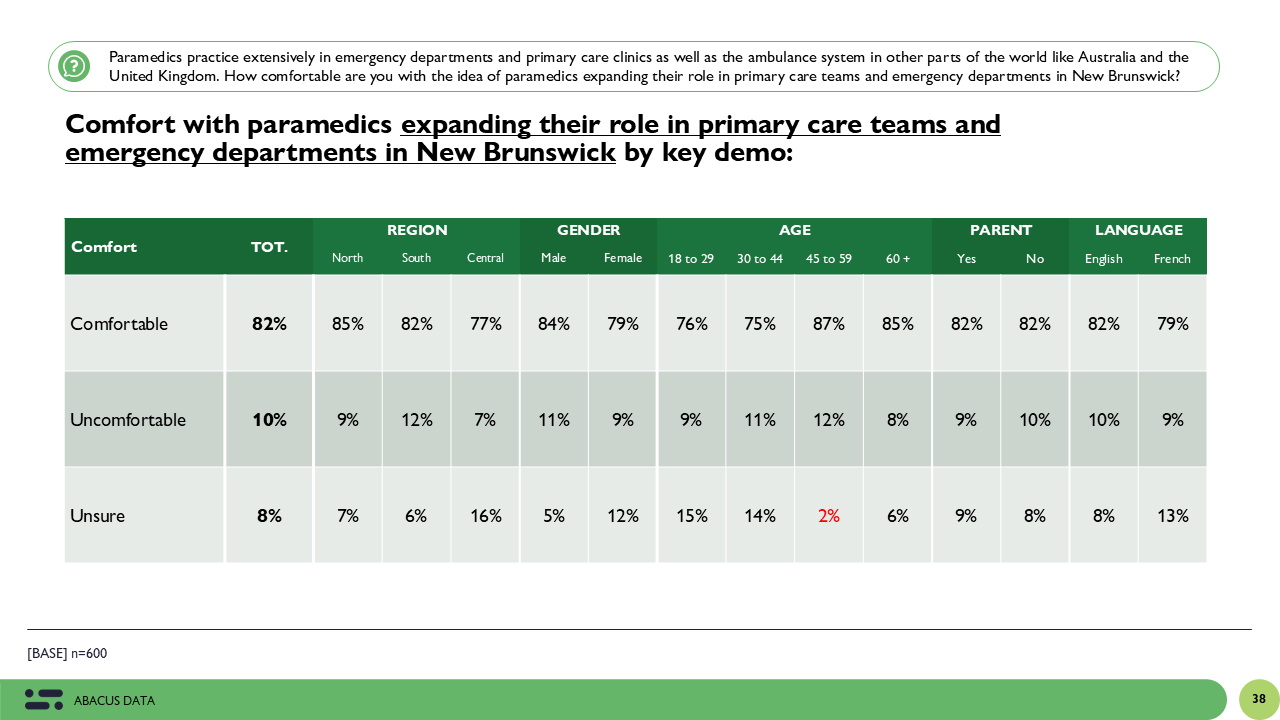
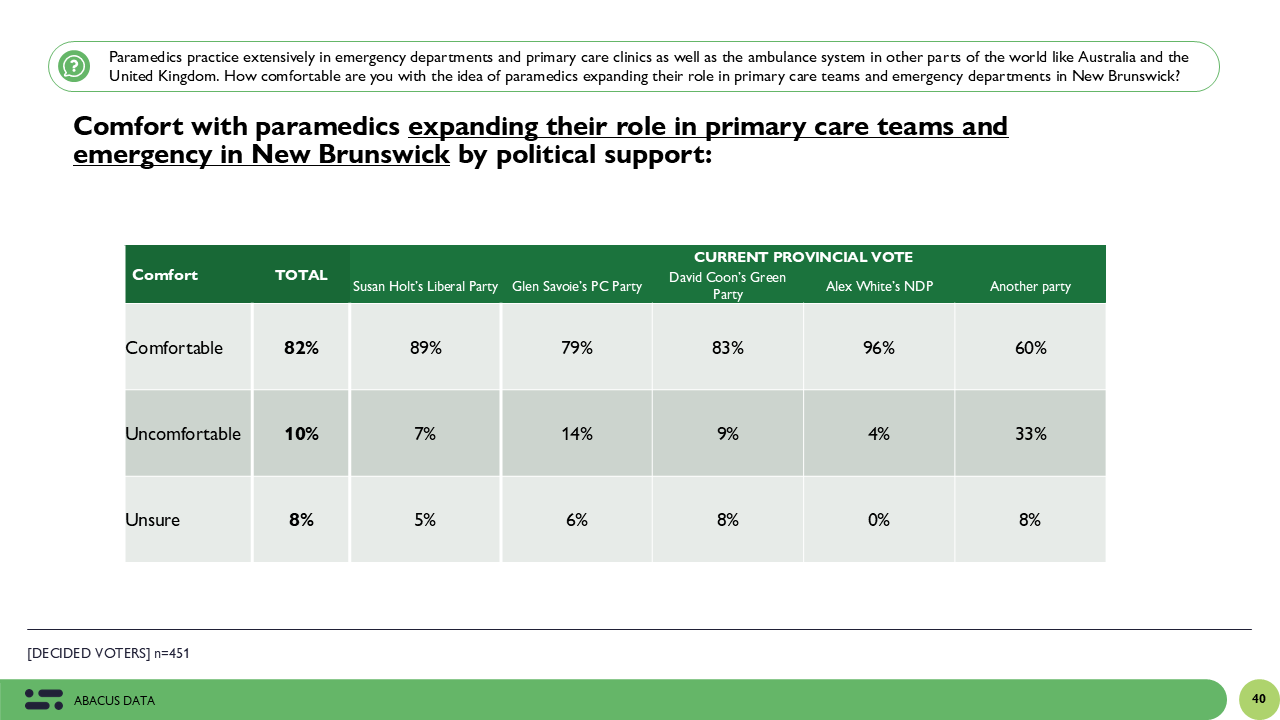
Openness to having (more) paramedics join primary care teams and work in emergency departments is extremely high in every region of the province and demographic group, including various party supporters.
86% Personally Comfortable Receiving Care from a Paramedic
The strongest sign of confidence comes when New Brunswickers are asked about their own care.
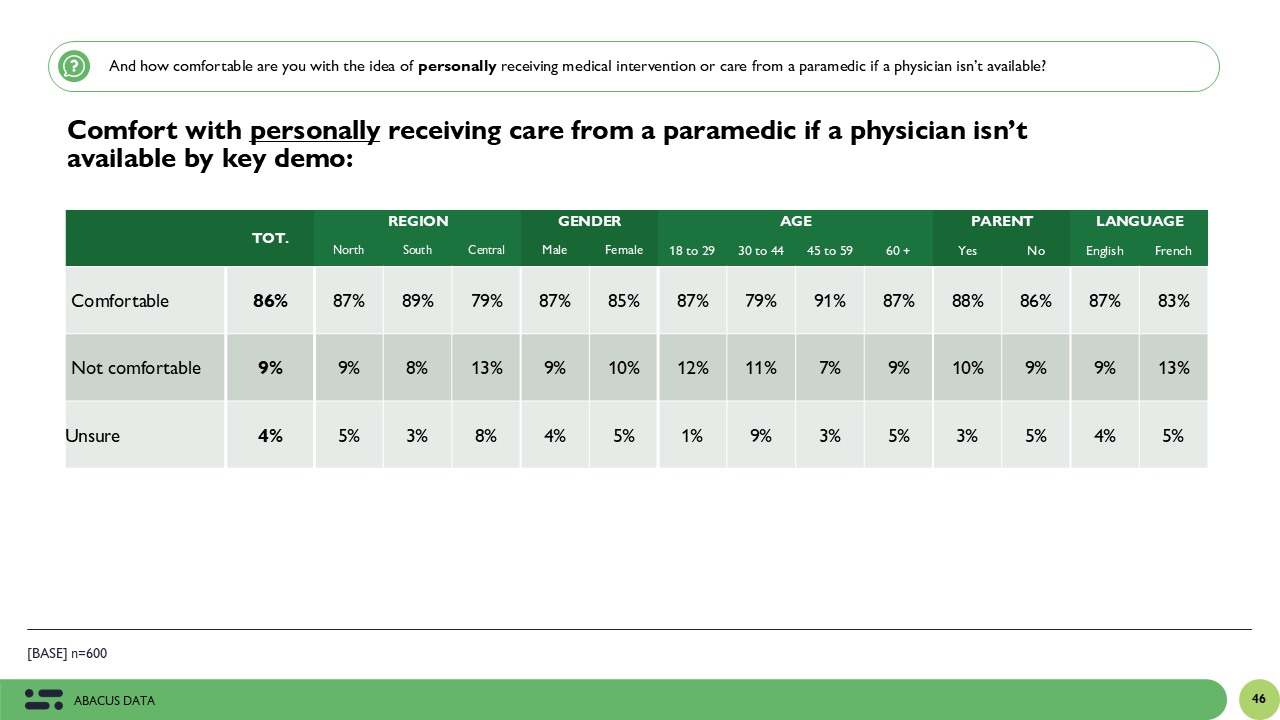
A remarkable 86% say they would be comfortable receiving medical intervention from a paramedic if a physician was not available.
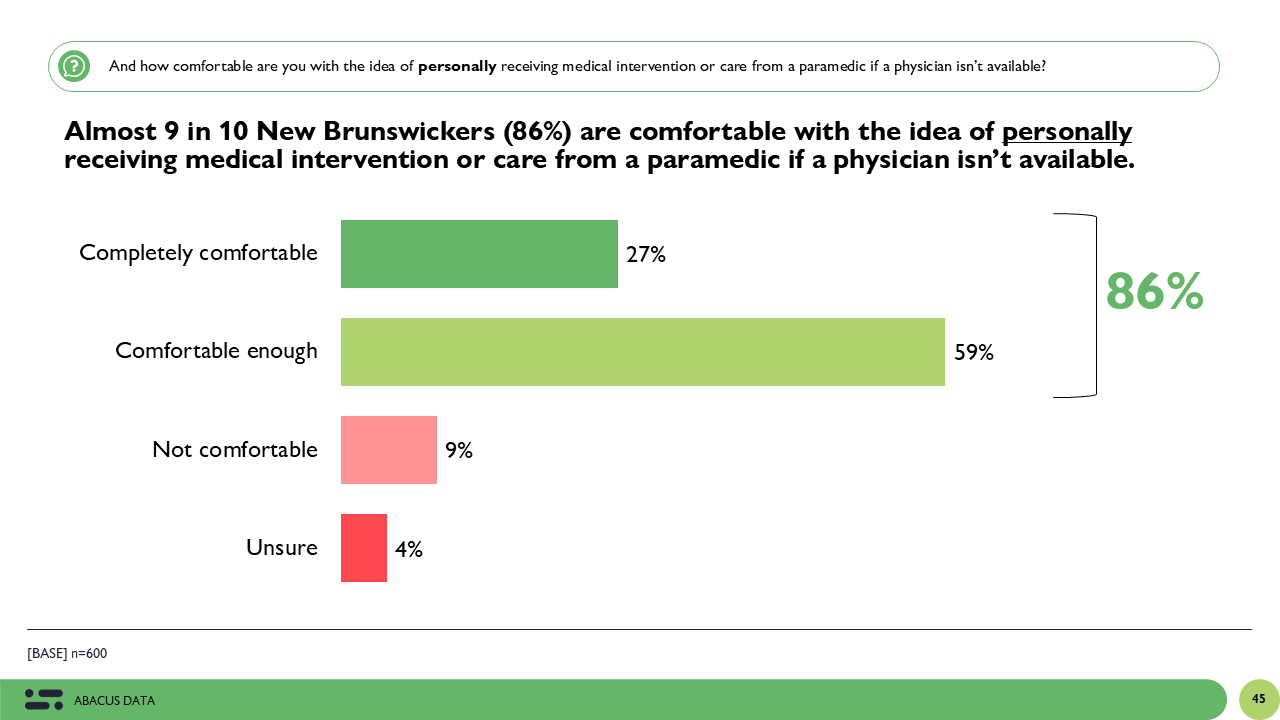
Comfort remains high across all age groups, including seniors, genders, and regions of the province.
Even among residents who are otherwise more critical of the health system, personal comfort with paramedic-delivered care remains extremely high.
This openness is likely driven by lived experience.
Many New Brunswickers have relied on paramedics in urgent situations or are close to someone who has done so. They trust their skills, their professionalism, and their ability to deliver care safely, with 60% of all New Brunswickers now considering the quality of paramedic and ambulance services in the province as “excellent” or “good” and a slighter higher proportion (62%) rating it as “excellent” or “good” in the community where they live.
The practical realities of seeing the province’s healthcare system under strain has also likely changed the way many people think about access to care and their own expectations for care. The current gaps in the system have probably made them more open to receiving care/treatment from a paramedic, because they think the likelihood of getting an MD is low.
This is another area where we have historical data to look back upon.
From our past research, we know that comfort with personally receiving medical care or intervention from a paramedic if/when a physician isn’t available is a little bit higher now than it was in 2023.
It currently sits at 86% compared to 84% two years ago, with that trendline being consistently high since 2021 (an early pandemic year).
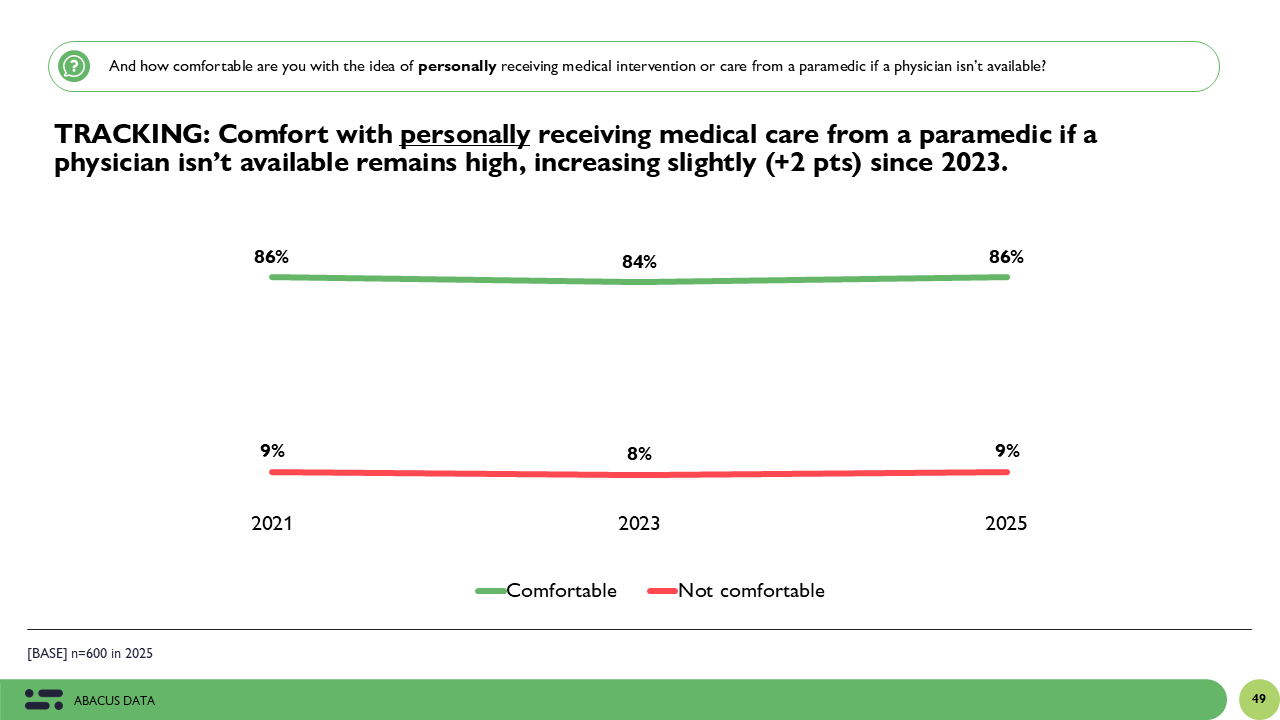
These results further demonstrate the high degree of trust New Brunswickers now have in paramedics and the connections they are making every day between paramedicine and “excellent” and “good” standards of care.
The Upshot
In 2025, New Brunswickers clearly see paramedics as part of the solution to addressing the province’s healthcare challenges. There is now broad recognition that paramedics are highly-skilled, medical professionals, performing well in a system under strain.
The research we are releasing today also shows that large majorities are comfortable with the idea of paramedics working alongside doctors and nurses in more healthcare settings. With 79% of New Brunswickers now saying they are comfortable with expanded roles for paramedics (in general) and 82% saying they are open to seeing paramedics working in primary care clinics and emergency departments, the pathway to change is clear.
Giving paramedics more responsibility is safe, practical, and economically responsible. It’s also the kind of positive action that the public wants to see from the Holt government as they continue to look for opportunities to bring bold change to New Brunswick.
About the New Brunswick Omnibus Survey
This research was conducted by Abacus Data through our New Brunswick Omnibus Survey, a new addition to our expanding portfolio of Atlantic Canadian products. The omnibus is a regularly scheduled survey, conducted in both French and English, with a representative sample of 600 New Brunswick residents (age 18 and over).
The survey was fielded online from October 24 to 30, 2025, using a random sample of panelists drawn from partner panels based on the Lucid exchange platform. The margin of error for a comparable probability-based random sample of this size is ±4.0 percentage points, 19 times out of 20. The data were weighted by age, gender, and region to ensure they reflect the province’s population according to the latest census data.
About Abacus Data
We are Canada’s most sought-after, influential, and impactful polling and market research firm. We are hired by many of North America’s most respected and influential brands and organizations.
We use the latest technology, sound science, and deep experience to generate top-flight research-based advice to our clients. We offer global research capacity with a strong focus on customer service, attention to detail, and exceptional value.
And we are growing throughout all parts of Canada and the United States and have capacity for new clients who want high quality research insights with enlightened hospitality.
Our record speaks for itself: we were one of the most accurate pollsters conducting research during the 2025 Canadian election following up on our outstanding record in the 2021, 2019, 2015, and 2011 federal elections.
Contact us with any questions.
Find out more about how we can help your organization by downloading our corporate profile and service offering.