Canadians split on Maduro’s removal but reactions hinge on views of Trump

January 16, 2026
Between January 9 and 14, 2026, Abacus Data surveyed Canadian adults as part of its national omnibus survey to understand how Canadians are processing the dramatic events in Venezuela following President Donald Trump’s U.S. military operation to remove Nicolás Maduro from power and take Maduro into U.S. custody. The intervention, announced on January 3, has triggered a fast moving and highly contested international debate, not only about Maduro’s record, but about the legality, legitimacy, and precedent of a U.S. led regime removal in the hemisphere.
Awareness and Attention Shape Reaction
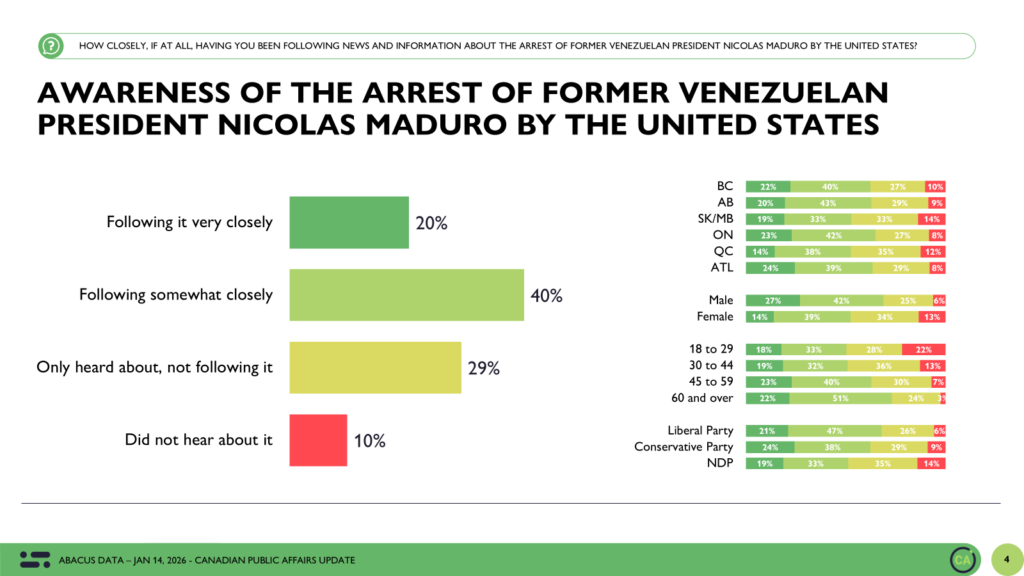
As is often the case with foreign policy events, most Canadians are not following every development closely. But the more important finding is what happens when attention increases.
A simple “reaction” Question that Reveals a Lot
To understand overall sentiment, the survey asked a second question that framed reaction in the simplest possible terms, whether the removal of Maduro is a good thing or a bad thing, all things consider. This kind of question is useful because it strips away policy detail and forces a gut level assessment. It does not tell us why people feel the way they do, but it offers a clean read on overall reaction.
Overall, 30% of Canadians think it’s a good thing overall versus 40% who think it’s a bad thing. Aother 29% have no clear views either way.

But reaction is sharply political.
While the survey finds Canadians divided overall, the differences by federal party support are pronounced. Conservative voters are far more likely to interpret Maduro’s removal as a good thing, while Liberal and NDP voters are much more likely to view it negatively. The event is being processed less as a question about Venezuela and more as a question about who is doing it, and what it signals about power, legitimacy, and precedent.
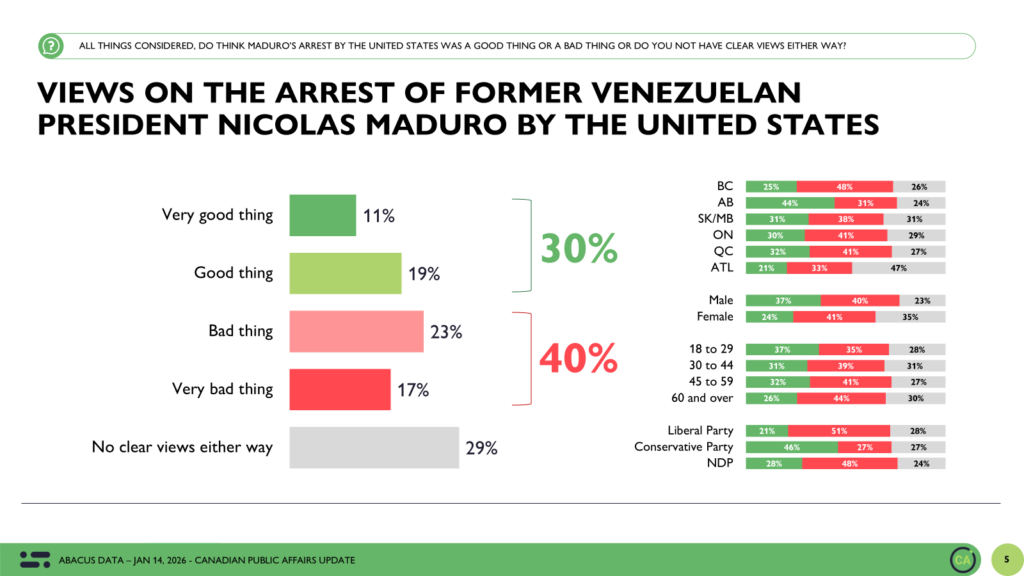
Moreover, among those paying closer attention to the events, opinion is not more unified, it is more defined. Fully 34% of those paying closer attention think Maduro’s removal is a good thing, while 48% think it is a bad thing. In other words, greater awareness does not automatically produce more support. It produces clearer judgement, and right now that judgement tilts negative among the most engaged.
Trump is the Lens and the Relationship is Strong
The strongest relationship in the data is not demographic. It is attitudinal.
Canadians’ impressions of President Trump are tightly connected to their reaction to Maduro’s removal, reinforcing the idea that for many people, this is not being evaluated as an isolated foreign policy outcome. It is being evaluated through the identity, intent, and credibility of the U.S. President who initiated it.
Only 13% of Canadians in this study say they have a positive impression of Trump. Among that small group, 75% think the overall event, Maduro’s removal, was a good thing. But among those with a negative impression of the U.S. President, just 20% see it that way.
That is an enormous gap, and it tells us something important about the political reality Canada is operating in. Even when the outcome might align with widely held views about Maduro’s regime, the messenger overwhelms the message.
The Upshot
This poll makes clear that much of the Canadian public is not evaluating Maduro’s removal in a vacuum. They are evaluating it through Donald Trump.
When we ask a simple question about whether this was a good thing or a bad thing, partisanship matters and impressions of Trump matter even more. Among those who like Trump, three quarters say Maduro’s removal is a good thing. Among those who dislike him, only one in five agree. That is not a marginal effect. That is a complete reframing of the event based on the identity of the actor behind it.
We also see that people who are paying closer attention are not more supportive. They are more likely to say this is a bad thing than a good thing. That should be a warning sign for anyone assuming that time and information will naturally move opinion in a positive direction.
The broader risk here is obvious. Cheering for Maduro’s removal may feel morally satisfying or strategically appealing. But in Canada, anything Donald Trump does is going to be seen through a deeply skeptical and, in some quarters, openly hostile lens.
That means even outcomes Canadians might otherwise welcome can become politically toxic when they are delivered by a figure many Canadians simply do not trust. This is not just a reaction to Venezuela.
It is a also reminder of how dominant Trump has become as a filter for Canadian opinion about the United States and the world.
Methodology
The survey was conducted with 1,850 Canadians from January 9 to 14, 2026. A random sample of panelists were invited to complete the survey from a set of partner panels based on the Lucid exchange platform. These partners are typically double opt-in survey panels, blended to manage out potential skews in the data from a single source.
The margin of error for a comparable probability-based random sample of the same size is +/- 2.3%, 19 times out of 20.
The data were weighted according to census data to ensure that the sample matched Canada’s population according to age, gender, and region. Totals may not add up to 100 due to rounding.
This poll was paid for by Abacus Data.