New Abacus Poll: Prime Minister Carney’s Standing Improves as Liberals Strengthen Ahead of Conservative Convention

January 30, 2026
Between January 22 and 27, 2026, Abacus Data surveyed 2,498 Canadian adults as part of our ongoing federal political tracking.
This wave lands at a politically consequential moment. Conservative Party members are set to gather in Calgary for a leadership review of Pierre Poilievre, while Prime Minister Mark Carney has just concluded a high-profile appearance at the World Economic Forum in Davos and a diplomatic trip to China. The survey was also conducted as Donald Trump reasserted himself into Canadian political discourse with a renewed threat to impose a 100 percent tariff on Canadian goods.
Taken together, the findings point to a modest but meaningful shift in the political environment. Public mood has improved slightly, government approval is up, and Mark Carney’s personal standing has reached its strongest level since he became Prime Minister. At the same time, Pierre Poilievre’s numbers have rebounded after two surveys that showed a rise in negative impressions, returning him closer to where he has been since the beginning of the year.
While the race remains competitive, the balance of momentum has tilted toward the Liberals in ways that are difficult to ignore.
Mood: Cautious Optimism Edges Up
Thirty-eight percent of Canadians now say the country is headed in the right direction, while 45 percent say it is on the wrong track. This represents a slight improvement from earlier in January and continues a gradual upward drift in optimism that began late last year.
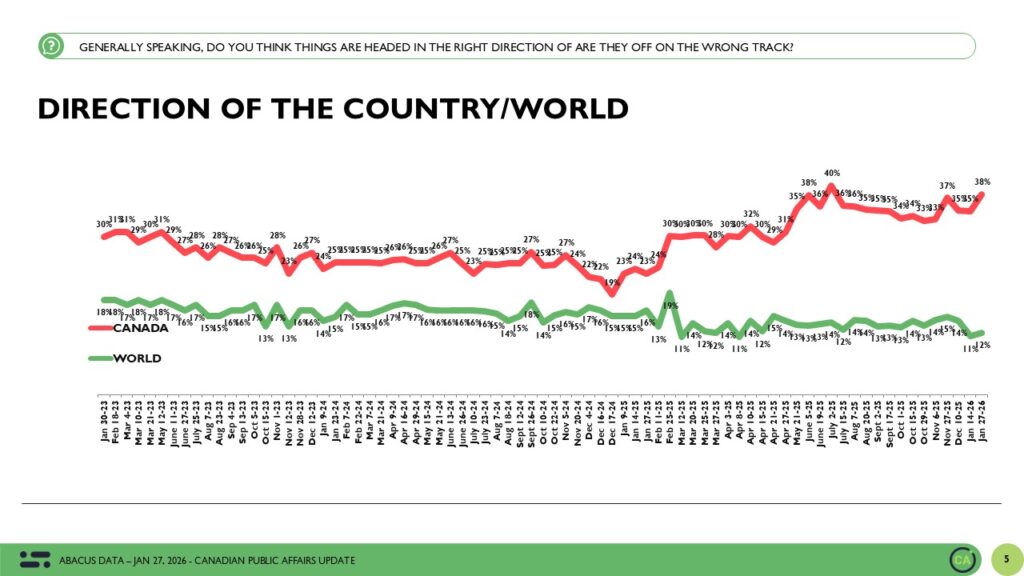
Views of the world remain deeply pessimistic. Just 12 percent believe the world is headed in the right direction, and 15 percent say the same about the United States. These views are broadly consistent across regions and demographic groups, underscoring how global instability continues to weigh on Canadian perceptions.
Optimism about Canada’s direction remains highest in Atlantic Canada and among older Canadians. Partisan differences are pronounced: Liberal supporters are far more likely to say the country is on the right track (62 percent), while Conservative supporters remain overwhelmingly negative (just 17 percent are optimistic).
Top Priorities: Affordability Dominates, Trump Remains Salient
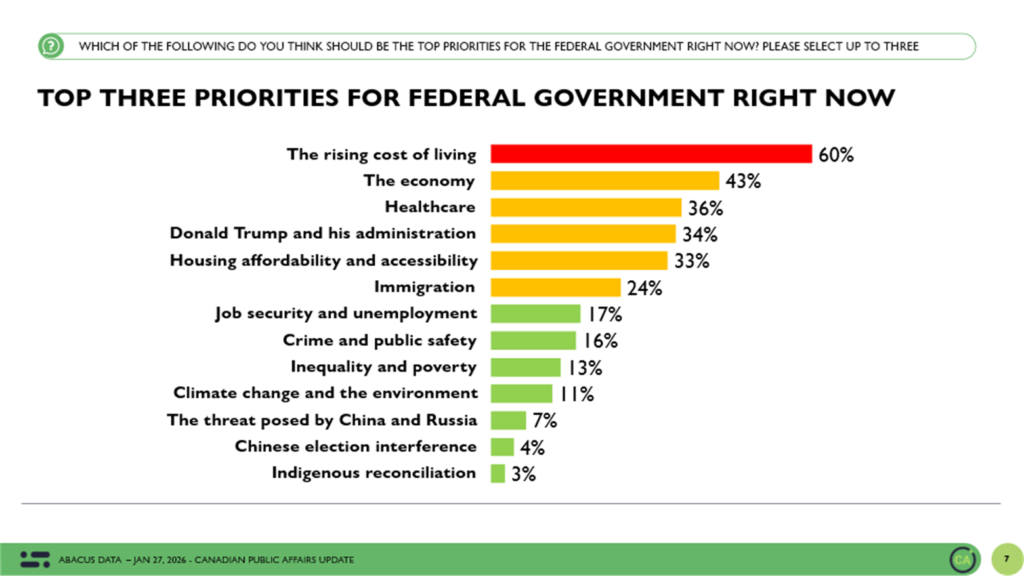
The rising cost of living remains the top federal priority, selected by 60 percent of Canadians. The economy follows at 43 percent, with healthcare close behind at 36 percent.
Donald Trump and his administration continue to rank among the top tier of concerns, cited by 34 percent of respondents. Housing affordability and accessibility (33 percent) and immigration (24 percent) round out the next tier. All of this is largely unchanged from earlier this month.
It is worth noting how fallen climate change and the environment has fallen down the list of priorities. Just 11% of Canadians now say one of their top priorities for the federal government is dealing with climate change and the environment compared to other issues.
Federal Government Approval Spikes Up
Approval of the federal government led by Mark Carney now stands at 54 percent, while 31 percent disapprove. This marks a clear improvement compared with earlier this month and places government approval at one of its strongest levels since Carney became Prime Minister. The last time the federal government had this level of approval was in May 2020 near the start of the COVID-19 pandemic.
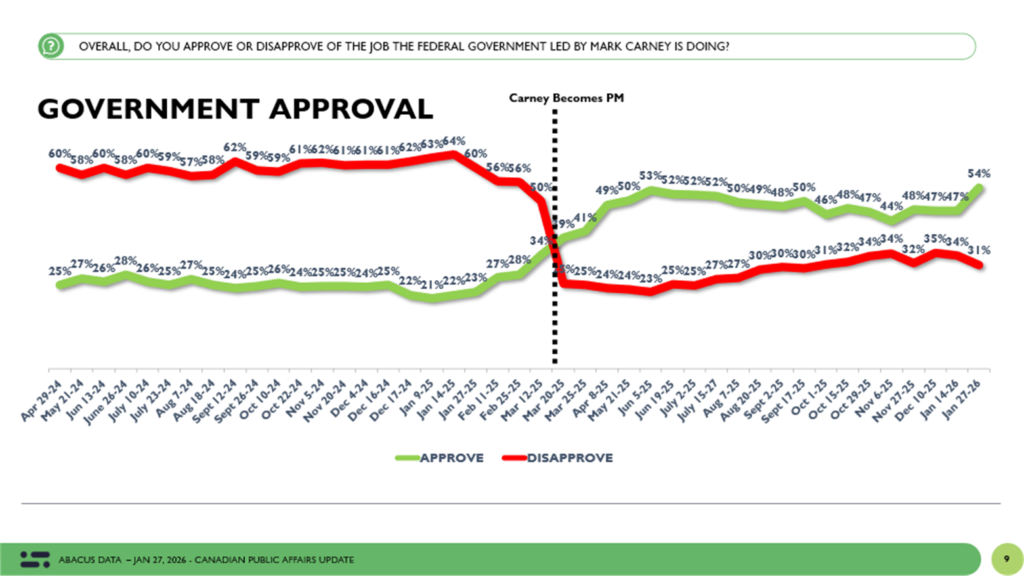
Notably, approval is not confined to the Liberal base. One in five Conservative supporters say they approve of the government’s performance while 53 percent of NDP supporters and 46 percent of BQ supporters feel the same way. This is a clear a signal that Prime Minister Carney’s approach is resonating beyond traditional partisan lines.
Leader Impressions: Carney Rises to Highest Level Yet, Poilievre Stabilizes
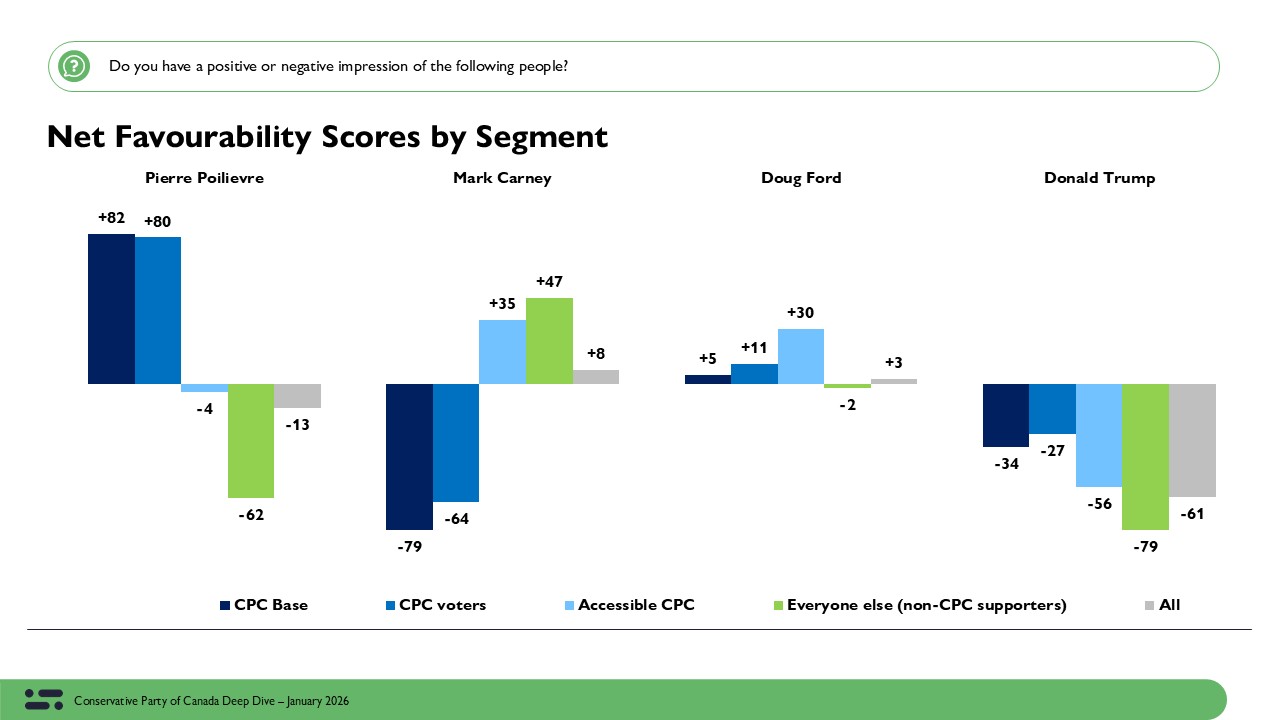
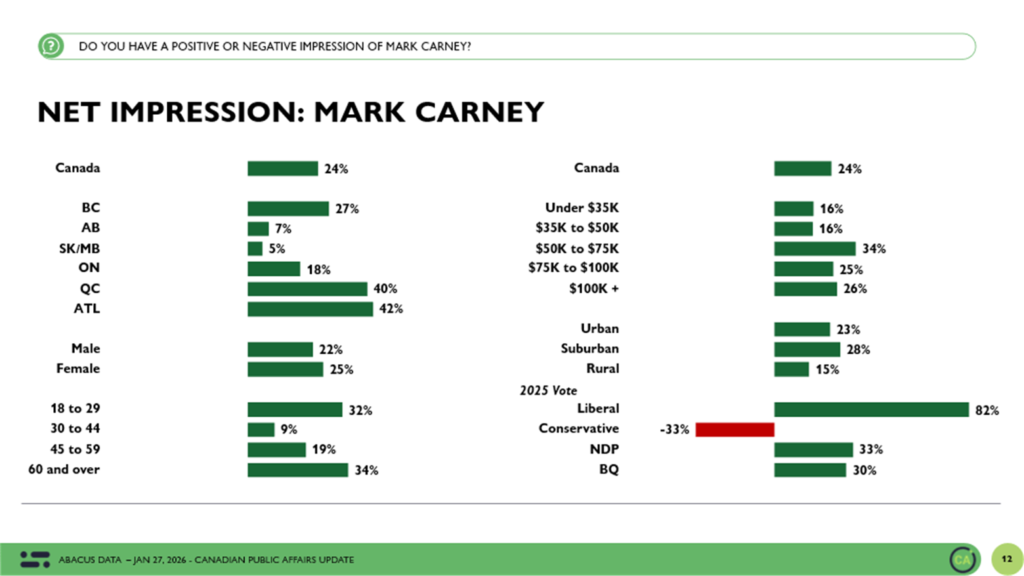
Mark Carney’s personal impressions have reached a new high. Fifty-three percent of Canadians now hold a positive view of the Prime Minister, while 30 percent hold a negative one, giving him a net favourable score of +23, the strongest result we have recorded.
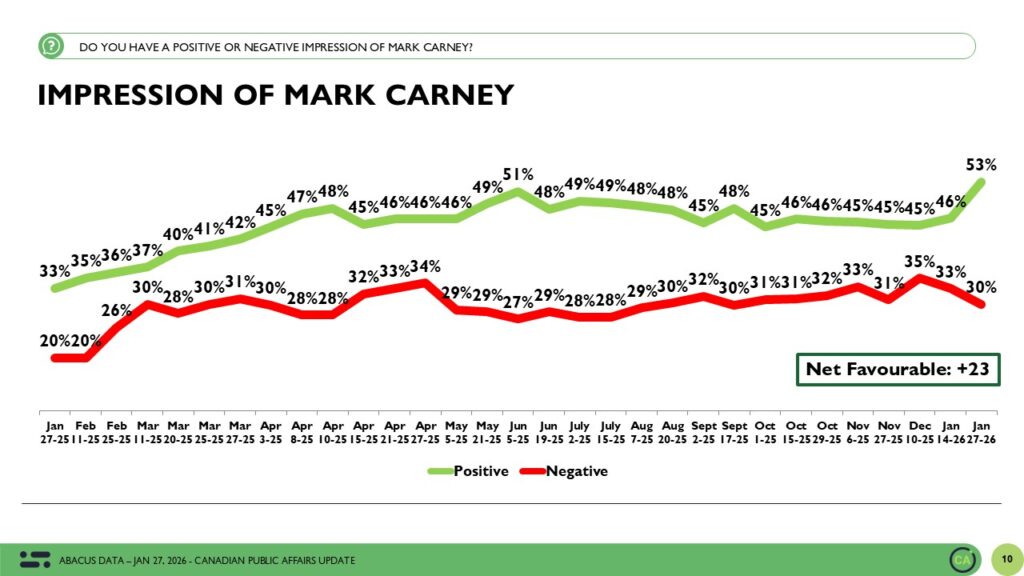
Carney is net positive across every region and demographic group, with particularly strong numbers in Atlantic Canada, Quebec, and among older and younger Canadians. Among Liberal voters, his net favourable rating is overwhelmingly positive (+82), but his strength extends beyond the base, reinforcing the sense of a broad and accessible coalition.
Pierre Poilievre’s numbers tell a different but important story. After two consecutive surveys that showed elevated negative impressions, his image has rebounded modestly. He now sits at a net impression of -6, close to where his numbers have been for much of the past year.
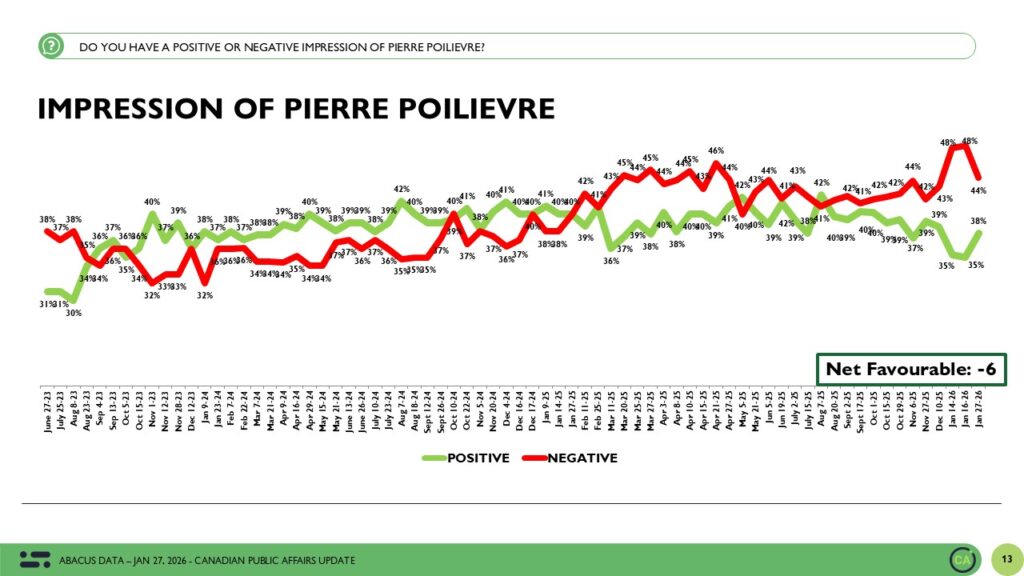
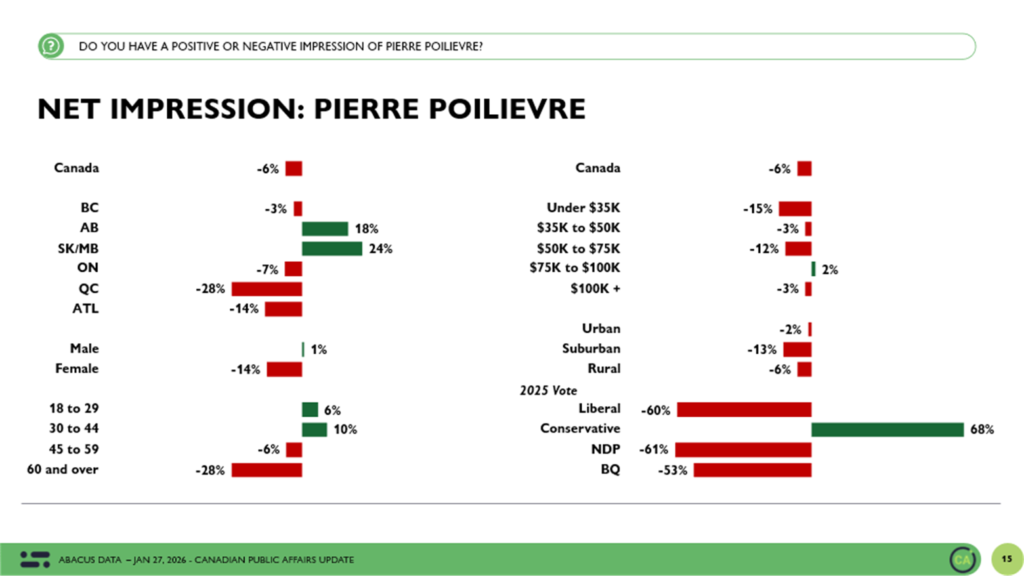
Poilievre continues to perform best among younger Canadians and in the Prairies, while remaining weakest in Quebec and among older voters. Among Conservative supporters, his standing remains quite strong (+68), but his broader appeal remains constrained outside the party.
Vote Intention: Liberals Edge Ahead
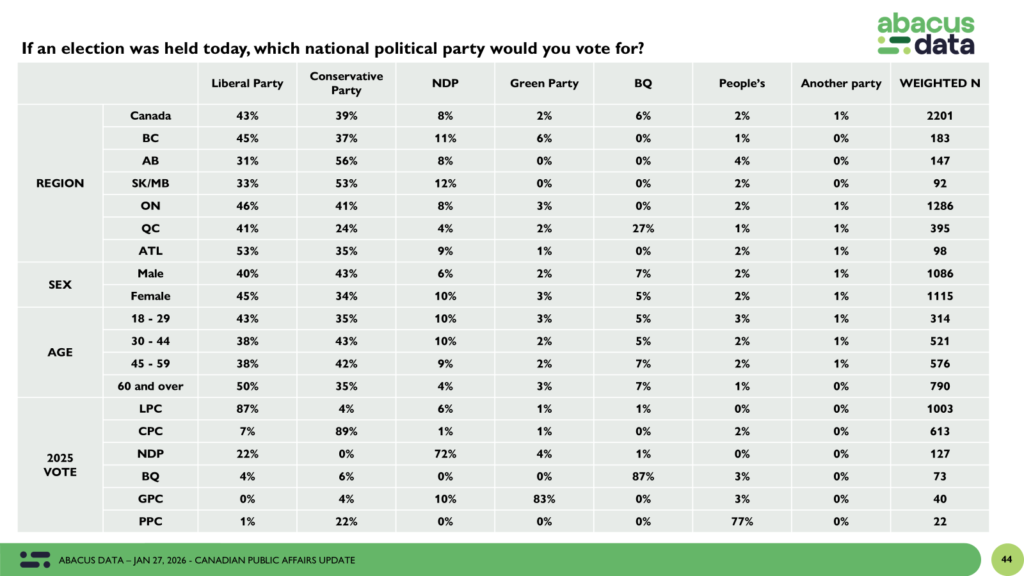
If an election were held today, the Liberals lead nationally with 43 percent, compared with 39 percent for the Conservatives. The NDP trails at 8 percent, followed by the Bloc Québécois at 6 percent, with the Greens and People’s Party each at 2 percent.
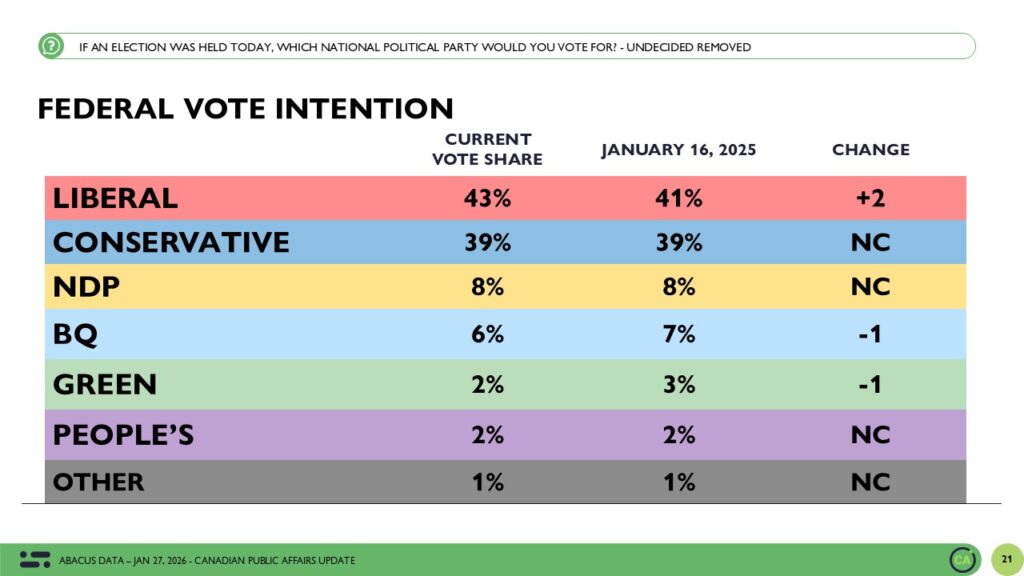
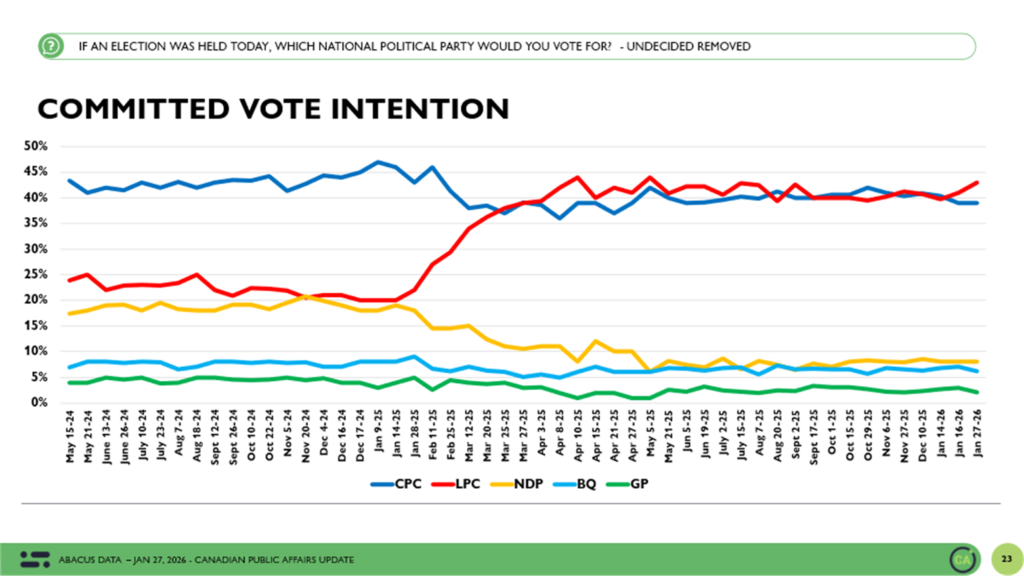
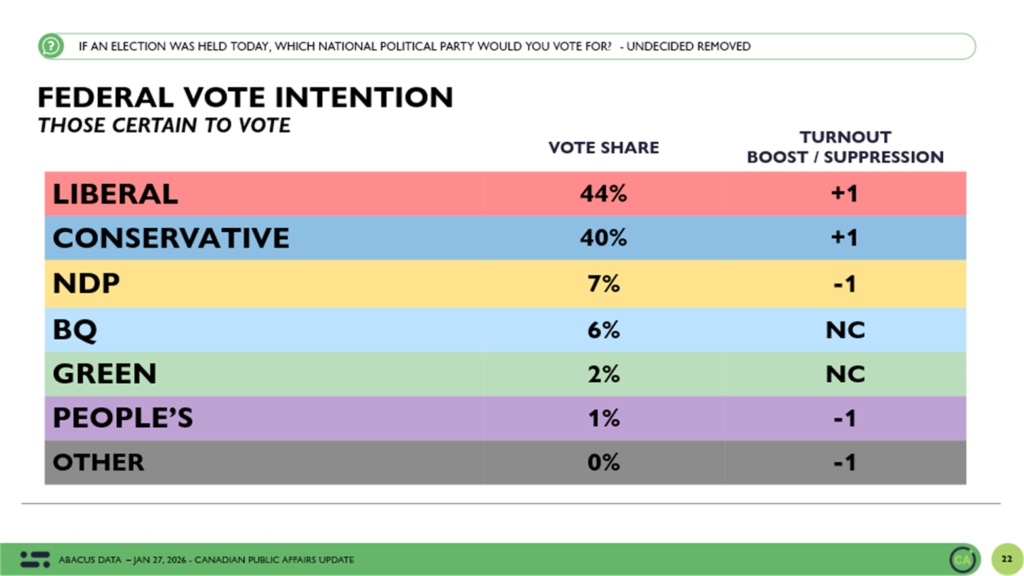
Among those most certain to vote, the Liberals hold a similar advantage.
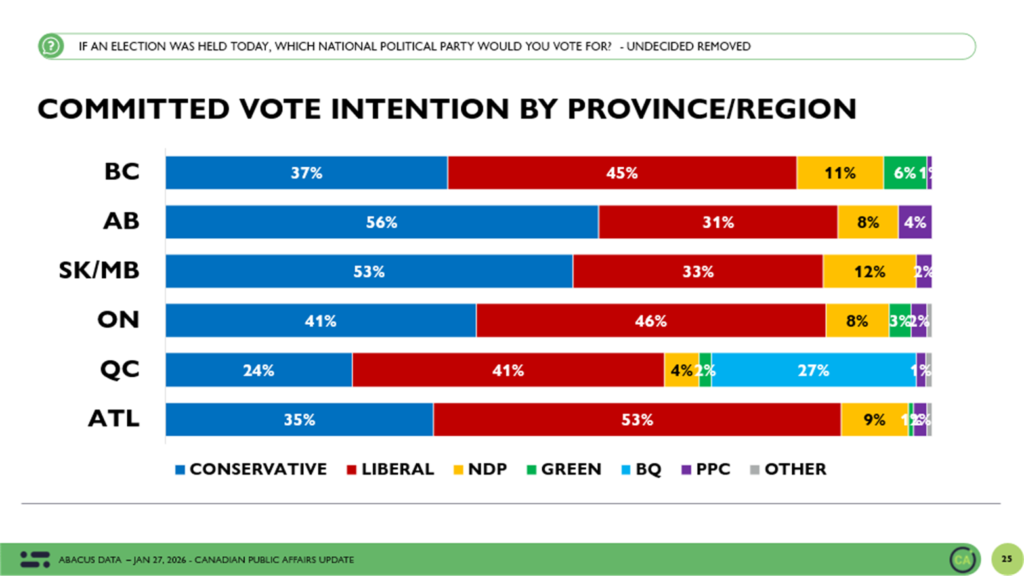
The underlying regional and demographic patterns remain largely intact. The Liberals continue to lead widely in Atlantic Canada and Quebec and hold a narrow lead in Ontario, while the Conservatives remain dominant in Alberta and the Prairies. The Liberals now lead by 8 in British Columbia.
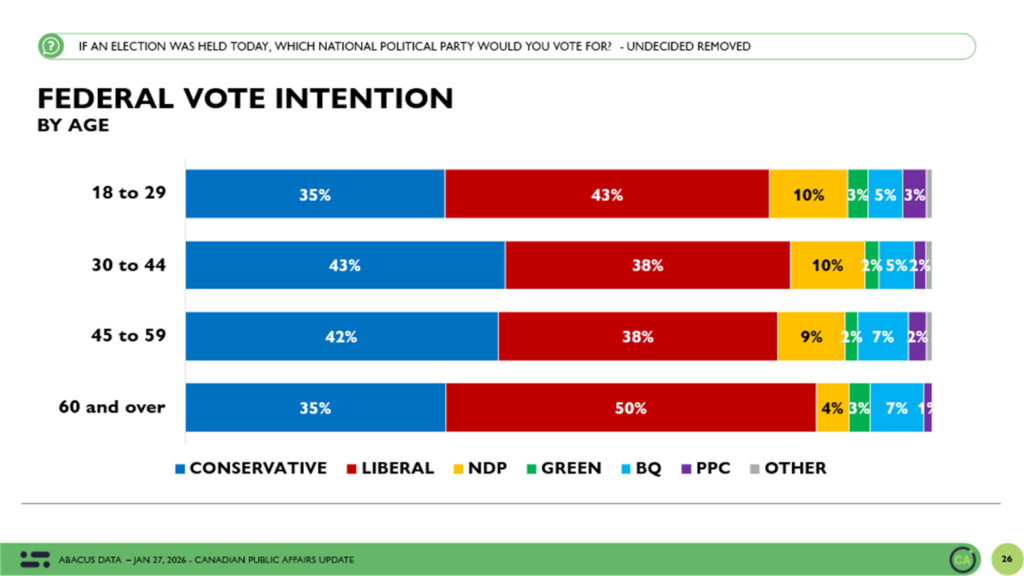
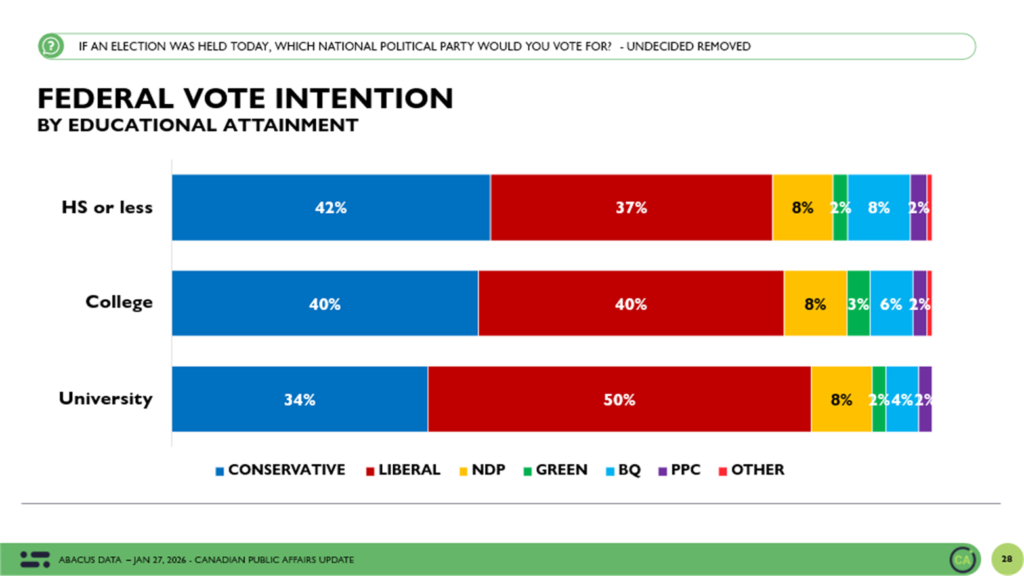
Age and education continue to be among the strongest dividing lines. The Conservatives lead among more middle-aged Canadians while the Liberals have established a lead among those under 30, a reversal from our last poll. They continue to have their largest lead among those 60+. The Liberals also maintain a substantial advantage among university-educated voters, while Conservatives lead among those with high school or college education.
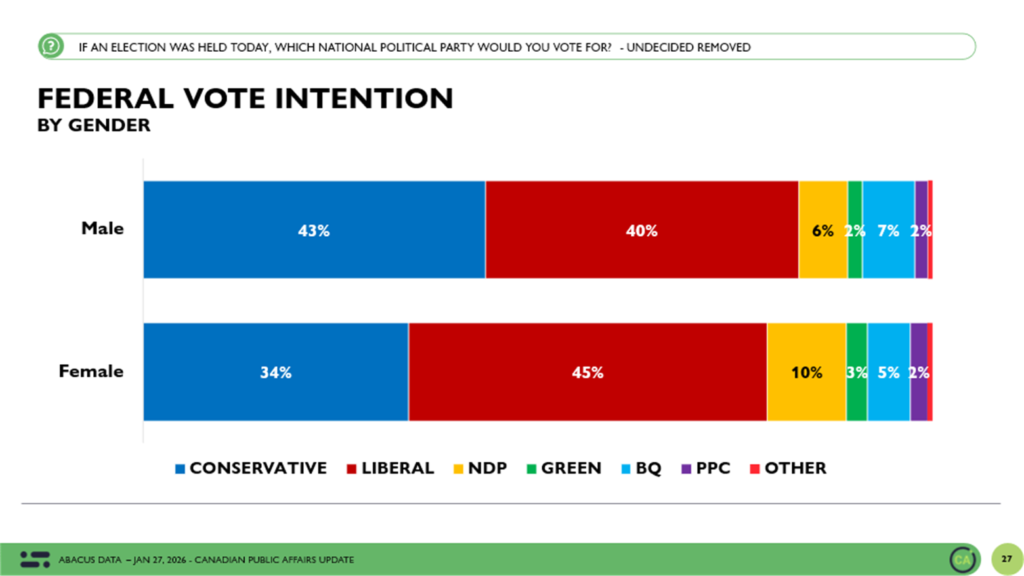
Conservatives have a three point lead among men while the Liberals now lead by 12 among women.
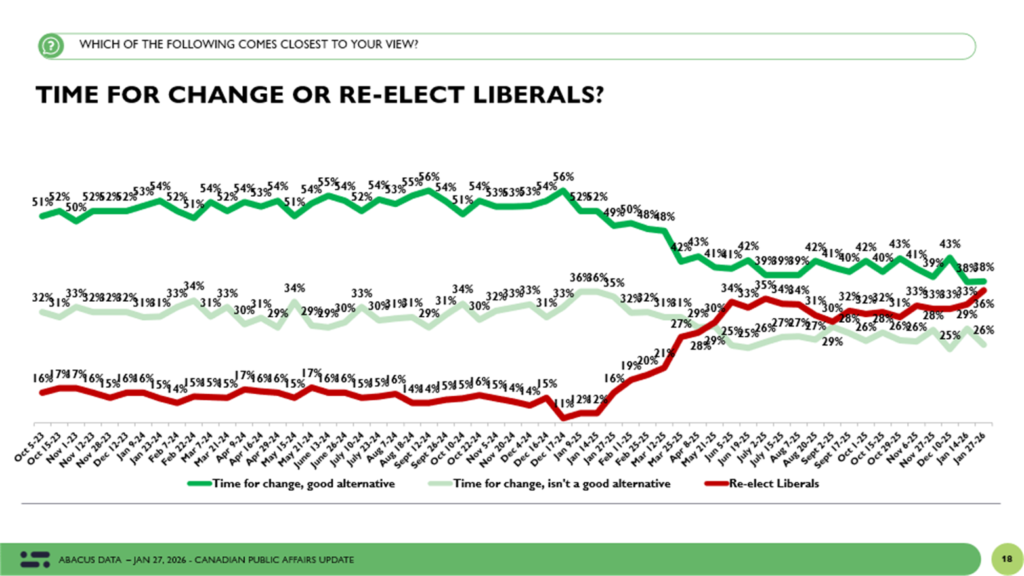
This grow in Liberal support is also reflected in our tracking on the desire for change. Today, 36 percent feel the Liberals deserve to be re-elected, the highest we have measured since we started tracking this measure.
The Upshot
According to Abacus Data CEO David Coletto:
“As Conservatives gather in Calgary to assess Pierre Poilievre’s leadership, this survey suggests the broader political environment has shifted in ways that are more favourable to the Liberals than at any point since the election.
Mark Carney’s personal standing is now at its strongest level we’ve measured, government approval has improved to a point not seen since the pandemic, and there are early signs of rising optimism about the country’s direction. Importantly, Carney’s appeal extends beyond the Liberal base, with a meaningful share of Conservative supporters approving of the government’s performance. The Liberals are approaching 40 percent of the entire electorate feeling they deserve to be re-elected.
Poilievre’s numbers have stabilized after a recent softening, but the contrast in momentum is clear. In a period marked by global uncertainty, renewed trade threats from Donald Trump, and heightened attention to Canada’s place in the world, voters appear to be rewarding steadiness and international credibility more than a desire for change domestically.
This does not mean the race is over or that the equilibrium has been permanently reset. But it does mean after a week or so of high profile events, the Liberals now find themselves in their strongest position since the election. What is harder to know for sure is whether this shift in opinion is a durable one given how many things are testing it at the moment.”
Methodology
The survey was conducted with 2,498 Canadians from January 22 to 27, 2026. A random sample of panelists were invited to complete the survey from a set of partner panels based on the Lucid exchange platform. These partners are typically double opt-in survey panels, blended to manage out potential skews in the data from a single source.
The margin of error for a comparable probability-based random sample of the same size is plus or minus 2.0 percentage points, 19 times out of 20.
The data were weighted according to census data to ensure that the sample matched Canada’s population. Totals may not add up to 100 due to rounding.